



The TOEFL test is undergoing MAJOR changes.
The good news is that we have the 10 best tips for the new TOEFL Reading so you know how to score high on test day.
So, what’s changing?
On January 21, 2026 the TOEFL Reading section was completely redesigned with three new task types:
- Complete the Words – Fill in missing words using context clues
- Read in Daily Life – Read and answer questions about emails, ads, and social media posts
- Read an Academic Passage – Read an academic passage and answer questions about it (like the old TOEFL, just a bit shorter)
The time it takes to complete the TOEFL Reading has changed as well.
Old Test: 36 minutes
New Test: 20-30 minutes
The structure of the test has changed as well.
Old Test: 2 Reading passages, 10 questions about each.
New Test: It varies from test to test, but here is an example. 1 Complete the Words passage, 2 Daily Life passages, and 1 Academic passage in part 1. Followed by 1 Complete the Words passage and 1 Academic passage.
If you would like to know more about these question types, try some of our free practice for each type here.
After carefully analyzing all of ETS’ free and paid practice tests and materials, I have updated our top 10 TOEFL Reading tips.
Let’s start with the basics:
Here is a quick rundown of our top ten TOEFL Reading tips:
- Tip #1: Learn the TOEFL Reading test structure
- Tip #2: Find keywords and focus on them
- Tip #3: Practice reading with a timer
- Tip #4: Beware of modifiers in answer choices
- Tip #5: Expand your academic vocabulary
- Tip #6: Learn word parts and apply to unknown vocabulary
- Tip #7: Be an active reader
- Tip #8: Study the same test more than once
- Tip #9: Explain why you were correct or incorrect
- Tip #10: Practice as much as possible.
By the end of this TOEFL article, you will not only know what to do on test day, but how to prepare in the days, weeks, and months ahead.
Let’s jump right in!
Tip #1: Learn the TOEFL Reading test structure
The last thing you want to feel on test day is lost.
It’s crucial you gain some exposure to these new passages before your test day.
There are three new TOEFL Reading task types:
- Complete the Words
- Read in Daily Life
- Read an Academic Passage
Check out the examples below for more details.
Complete the words
Complete the Words (from TST Prep Test #2)
The water cycle describes how water constantly moves through Earth’s air, land, and oceans. Wh _ _ the s _ _ warms the sur _ _ _ _ , some wa _ _ _ changes in _ _ vapor and ri _ _ _ . That va _ _ _ cools i _ the s _ _ and fo _ _ _ clouds that eventually release rain or snow. The water then returns to rivers and lakes before starting the cycle again. This natural process keeps fresh water available and helps control the planet’s temperature. Scientists study it to understand and make predictions about the weather and climate.
Complete the Words passage types are about 90 words long and consist of 10 incomplete words. Your job is to fill in the blanks and spell the words correctly.
This will be the first question type you see on test day. It measures your vocabulary, spelling, and ability to recognize patterns in English through context clues.
Read in Daily Life (from TST Prep Test #2, Text Chain from TST Prep test #1. )
Read an email

Read an announcement

Read a text chain
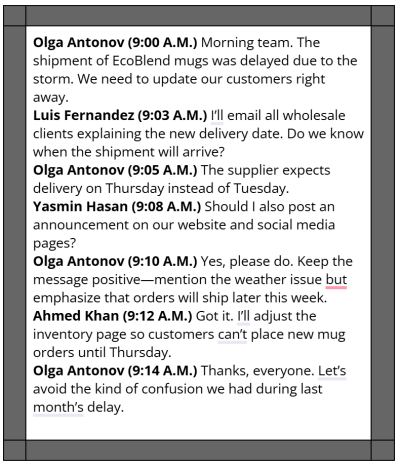
Hey, why are there three different examples of Read in Daily Life?
Good question.
It’s because there is a short Read in Daily Life, like the first email above, a longer Read in Daily Life like the announcement, and a text chain passage, which was the last one listed.
The text chain is rare and shows up in about 10-20% of ETS’ TOEFL Practice tests (TPO).
You will definitely see at least one short daily life task and at least one long daily life task on test day.
These short texts are designed to see if you can read quickly and understand common grammar and vocabulary that you would encounter in everyday life.
Read an Academic Passage
Arctic Sea Ice and Global Climate
Arctic sea ice forms when ocean water freezes during winter and partially melts each summer. Over the past few decades, satellite observations have revealed a consistent decline in both the area and thickness of this ice. Scientists consider these measurements an important indicator of global climate change.
When sea ice melts, the darker ocean surface beneath it absorbs more sunlight, leading to additional warming—a process known as the ice-albedo feedback. This effect not only accelerates melting but also influences weather patterns far beyond the Arctic. Researchers have linked declining ice cover to shifts in jet streams and more extreme weather in temperate regions.
Melting sea ice also affects marine life. Species such as polar bears and seals depend on stable ice platforms for hunting and breeding. As these platforms disappear, animals must travel farther to find food, and survival rates drop. Indigenous communities that rely on sea ice for travel and hunting face similar challenges as their traditional routes become unsafe.
Scientists are monitoring seasonal cycles to understand how long-term warming might alter global ocean currents. Small changes in these currents can disrupt ecosystems and even affect rainfall patterns worldwide.
The academic texts are similar to the old version of the TOEFL iBT but MUCH shorter. In the past, the passages were around 700 words long. The new test passages will be about 200 words long, followed by five questions.
This measures your ability to read texts you would encounter in a freshman-level university classroom in North America. You will have to make inferences, understand academic vocabulary, and identify the main idea of each passage.
Another key change to the TOEFL Reading in 2026:
Fewer academic questions.
The older version of the TOEFL Reading section had at least 20 questions about two reading passages. In this new version, you will have just 10 questions at most about the academic readings.
Tasks 1 and 2 are completely new formats that test practical, everyday reading skills. You still have to answer questions about the passages, but they are not as complicated as previous questions about academic passages.
Understanding Adaptive Testing (New in 2026)
One more thing you should know is that the new test includes two modules.
What’s a module?
It’s basically a fancy way of saying “part”.
A typical Module 1 (part 1) would look something like this:
- 1 Complete the Words passage
- 2 Daily Life passages
- 1 Academic Passage
This first module is designed to assess how well you are doing on the test. In other words, Module 2 will change based on your performance.
From the research I have done on the TPOs at ETS’s official website, there seem to be two types of second modules:
If you are doing well, Module 2:
- 1 Complete the Words passage
- 1 Academic passage
If you are struggling, Module 2:
- 1 Complete the Words passage
- 1 Daily Life passage (short)
- 1 Daily Life passage (long)
ETS has implemented this change to help improve the TOEFL experience for test-takers. No one wants to keep answering hard questions when they are struggling.
No matter what, focus on doing well in Module 1. It’s better to slow down and get Module 1 right than to rush and lock yourself into easier (lower-scoring) Module 2 questions.
If you get an easier Module 2, it lowers your score ceiling, and you want to avoid that if possible.
That is why tip #1 is for you to know the new passage types before test day.
Once you have become familiar with them, tip #2 will become much more useful.
Tip #2: Memorize the question types
One tricky aspect of the TOEFL Reading is the question types. There are multiple question types you will have to know before test day.
For the Daily Life tasks, there are four:
|
The Reading Section – Daily Life Passages |
|||
|---|---|---|---|
| Question Type | Frequency per Test | Question Wording | Question Example |
| Gist Purpose | 1–3 | What is the purpose of… | What is the main purpose of this notice? |
| Factual Information | 2–5 |
• What should XX do… • What will happen if… • According to the announcement… |
What should Mr. Lee do before the tour begins? |
| Negative Factual Information | 0–2 |
• Which of the following is NOT… • All of the following… EXCEPT |
Which of the following is NOT true according to the message? |
| Inference | 1–3 | What can be inferred about… | What can be inferred about the museum’s policy? |
Why is it important to know these question types?
Because if you don’t understand the question, you will arrive at the wrong answer.
For example, many test-takers get Negative Factual Information questions wrong.
Why?
Take this example from TST Prep Test #1:

Which of the following actions is NOT mentioned in the messages?
- Contacting wholesale clients by email
- Posting an update on social media
- Adjusting the inventory page
- Calling the supplier by phone
I had one student argue with me that the correct answer is option a because in the text chain, Luis Fernandez states, “ I’ll email all wholesale clients explaining the new delivery date.”
Do you see why the student is wrong?
It’s because this is a NEGATIVE factual information question. You have to find what is NOT mentioned in the passage, in this case option d is correct because it is never mentioned.
Unfortunately, the Academic Text passages include even MORE question types.
|
The Reading Section – Academic Text Passages |
|||
|---|---|---|---|
| Question Type | Frequency per Test | Question Wording | Question Example |
| Gist Content | 1–2 | What is the main idea… | What is the main idea of the passage? |
| Factual Information | 2–4 |
• According to the passage… • What… |
According to the passage, what happens when the ocean surface is exposed? |
| Negative Factual Information | 0–1 | • All of the following… EXCEPT | All of the following are true about the impact of printing EXCEPT |
| Author’s Purpose | 1–2 | Why does the author mention… | Why does the author mention the Phoenician alphabet? |
| Insert Text | 0–1 | There are four locations… | There are four locations in the passage marked (A), (B), (C), and (D). Where would the following sentence best fit? |
| Vocabulary | 1–2 | The word XX in the passage… | The word “fragile” in the passage is closest in meaning to |
| Inference | 0–2 | What can be inferred about… | What can be inferred about the museum’s policy? |
| Organization | 0–2 | What is the relationship between… | What is the relationship between paragraphs 2 and 3? |
| Click the Sentence | 0–1 | Click on the sentence that… | Click on the sentence in paragraph 4 that explains how changes in ocean currents could have worldwide consequences. |
I know this can feel a bit overwhelming, which is why we have over 100 free TOEFL Reading practice questions here so you can know exactly what to expect on test day.
Now that you know the passages and you know the question types, you can start thinking about how to manage your time.
Tip #3: Keep track of time
On test day, you will answer 35-48 questions across both modules. Depending on the number of questions you receive, you will have between 21-30 minutes to complete the entire section.
Here is a rough estimate of how long you should spend on each passage type:
- Complete the Words: 1-2 minutes per passage (complete 10 blank words)
- Read in Daily Life (short): 1-2 minutes (read and answer 2 multiple-choice questions)
- Read in Daily Life (long): 2-3 minutes (read and answer 3 multiple-choice questions)
- Text Chain: 2-3 minutes (read and answer 3 multiple-choice questions)
- Read an Academic Passage: 4-5 minutes (read and answer 5 multiple choice questions)
One of the best ways to see if you are answering the questions fast enough is to time yourself.
So let’s do that right now.
Set a timer for two minutes and try this Complete the Words passage from TST Prep test #2.
The water cycle describes how water constantly moves through Earth’s air, land, and oceans. Wh _ _ the s _ _ warms the sur _ _ _ _ , some wa _ _ _ changes in _ _ vapor and ri _ _ _ . That va _ _ _ cools i _ the s _ _ and fo _ _ _ clouds that eventually release rain or snow. The water then returns to rivers and lakes before starting the cycle again. This natural process keeps fresh water available and helps control the planet’s temperature. Scientists study it to understand and make predictions about the weather and climate.
And here are the answers:
The water cycle describes how water constantly moves through Earth’s air, land, and oceans. Wh{en} the s{un} warms the sur{face), some wa{ter} changes in{to} vapor and ri{ses}. That va{por} cools i{n} the s{ky} and fo{rms} clouds that eventually release rain or snow. The water then returns to rivers and lakes before starting the cycle again. This natural process keeps fresh water available and helps control the planet’s temperature. Scientists study it to understand and make predictions about the weather and climate.
Were you able to answer all of the questions correctly in two minutes?
If not, that’s okay, it takes time to get used to. Either way, be sure to set a timer when you practice for the TOEFL Reading section. Many test-takers struggle to answer all of the questions in time.
Tip #4: Beware of modifiers in answer choices
One way to eliminate wrong choices and select the correct one is to pay close attention to modifiers.
First of all, what’s a modifier?
A modifier is a word, usually an adjective or noun that changes the meaning of the head noun. The wrong modifier can change the significance of a statement.
The best way to understand is to look at a few examples:
- This event has had a tremendous impact
- This event has had some impact
- This event has had almost no impact

As you can see, modifiers are an easy way to make a possible choice incorrect. All you have to do is change a single word and it changes the entire meaning of the sentence. This is one of the more infamous trap answers on the TOEFL, so be sure not to fall for the modifier trap. There is a huge difference between “tremendous impact” and “almost no impact“.
Tip #5: Expand your academic vocabulary
Since there are some academic passages in the TOEFL Reading, the vocabulary is also at the academic level.
So, why does this matter?
You probably already know that you should study academic vocabulary, but did you know that there is an actual Academic Word List? It was created by linguist Averil Coxhead in 2001 and it contains 570 of the most common academic words used in scholarly journals and texts.
You can get yourself a copy of the Ultimate TOEFL Vocabulary List.
Here’s a quick example of one of the academic vocabulary words and all of its variations:
- Verb form(s) – adapt
- Noun form(s) – adaptation, adaptability
- Adjective form(s) – adaptable, adaptive
- Adverb form(s) – adaptively
Let me make something clear…
You do NOT have to know all the forms of a single word. The point is that if you know the simple verb form, (i.e. acquire), then you can probably figure out the meaning of the other forms of the same word. Don’t memorize every word in each word family, just focus on familiarizing yourself with the headword.
Understanding these words won’t guarantee that you will know every word you encounter in the TOEFL Reading but this is the most concise vocabulary list you can find.
There are other sites that promote TOEFL Vocabulary Lists of thousands of words, but all you need for the TOEFL Reading section is to focus on these 570 words.

Tip #6: Learn word parts and apply to unknown vocabulary
In addition to learning academic vocabulary, it’s beneficial to learn the parts of words, i.e., the prefixes, suffixes, and roots of words.
Knowing that “ex-” means “out of or not“, or that “pro-” means “before or forward” will you give you the advantage of being able to dissect words that you do not completely understand.
Whether you like it or not, there will be words in the TOEFL Reading section that you simply do not know. This TOEFL Reading tip will not only help you with vocabulary questions but for any part of the text you do not fully comprehend.
The problem is that there are literally thousands of word parts and some are more useful than others. Here is a link to our Essential Word Parts List, which includes all 219 word parts that can help you discern the meaning of a word, even if you are unfamiliar with it.
Below is a list of our 54 most common prefixes. You can find the rest in our Essential Word Parts List.
Group 1 – Location and Movement
- ab – away from, down – abandon, abstain, abnormal, absurd, abominable
- ad – at, towards – admire, adapt, adjacent, admonish, adversary
- circum – to go around, circle – circumvent, circumstance, circumstantial, circumference, circumcise
- con-/co-/com-/col – together – collect, company, concentrate, converge, coexist
- dia – through, across – dialogue, diachronic, diameter, diatribe, diagram
- equi – equal – equidistant, equity, equilibrium, equinox, equivalent.
- ex – out of, not – exposure, exaggerate, exonerate, exude, exclusion
- fore – front, in advance – foreground, forearm, forecast, foreclose, foreshadow
- in – in, on, not – inception, intone, insinuate, incorrect, inaccurate
- inter – among, between – interaction, intercept, intermediate, interject, international
- para – besides, irregular, beyond – paramedic, paranormal, paragraph, paraphrase, paranoid
- per – thoroughly, through – perceive, persist, peruse, persevere
- peri – about, around, near – periodical, periscope, perimeter, peripheral
- pro – before, forward – procession, proficiency, prominent, prologue, prognosis
- sub – under, below, slightly imperfect – subatomic, subconscious, subdivide, subjugate, submission
- syn-/sym – with, together – sympathetic, synergy, synonym, symbiotic, symmetrical
- tele – afar, at a distance – telecast, telecommunication, telephone, telescope, television
- trans – through, across, beyond – transcript, transfer, transcendence, transport, transaction
Group 2 – Numbers
- bi-/du – two – duplicate, dual, bisexual, biweekly, bipolar
- cent – 100 – centenarian, century, centigrade, centimeter, centipede
- mill – 1000 – millennium, milliliter, milligram, millennial, millipede
- mono – one – monochrome, monotone, monogamy, monopolize, monotheism
- multi – more than one – multicellular, multicultural, multimillionaire, multitask, multifaceted
- poly – many – polyglot, polygamy, polyphonic, polytheism, polygon
- quad – four – quad, quadriplegic, quadrangle, quadruplet, quadriceps
- tri – three – tricycle, tripod, trio, trimester, triad
- uni – one, together – unicorn, unicycle, unify, uniform, universal
Group 3 – Negatives
- anti – against, opposite of – antidepressant, antitrust, antiwar, antidote, antisocial
- contra– against, in opposition of – contraband, contraceptive, contrast, contrarian, contradiction
- dis – away from, the reverse effect – disable, disadvantage, disarm, displace, disrupt
- il-/im-/in-/ir – not, opposite of – illegal, imbecile, irregular, inability, inconsistent, illogical
- mal – wrong, badly – malefic, malcontent, malpractice, malnourished, malevolent
- mis – wrong, incorrect – misjudge, mislead, misprint, mistreat, misfortune
- non – not – nonchalant, noncompliant, nonexistent, nonrenewable, nonfiction
- un – negative, opposite force – unacceptable, uneasy, unhinged, unrealistic, unspeakable
Group 4 – Academics
- astro – the stars, outer space – asteroid, astrology, astrolabe, astronaut, astrophysicist
- geo – earth – geometry, geothermal, geography, geolocation, geometric
- hydro – water – hydroelectric, hydrometer, hydrophobia, hydropathic, hydrodynamic
- neur – nerves, nervous system – neuron, neurological, neuropathy, neurosis, neurosurgeon
- psych – mind, spirit, that which breathes – psychedelic, psychic, psycho, psychosis, psychotic
- socio – social, society – sociocultural, socioeconomic, sociolinguistic, sociopolitical, sociopath
Group 5 – More Prefixes
- ana – back, again, upwards – anagram, analogy, anatomy, anachronism, analyze
- auto – by oneself, itself – autobiography, autocracy, autograph, automatize, autonomy
- em, en – to cause to be in, to confine – embark, embezzle, entourage, enjoin, encroach
- hyper – over, exaggeration – hyperactive, hyperbolic, hyperlink, hypertension
- meta – after, change, beyond – metamorphosis, metaphysical, metadata, metabolism, metaphor
- neo – new – neologism, neolithic, neofascist, neon, neonate
- over – more than usual, too much – overcooked, overachiever, overeducated, overdose, overslept
- pan – all – pandemic, panorama, Pangea, pan, panacea
- post – after – postmortem, postmodernism, posterity, postscript, postseason
- pre – before – precaution, preconditioned, predestination preordain, preview
- re – back, again – rebuild, recall, recede, reflect, reconsider
- super – above, beyond – superimpose, superlative supernova, superstar, superrich
- ult – last, beyond – ultraconservative, ultrasound, ultimatum, ultimate, ulterior
Remember, using word parts will not always work. The prefix “ab” may mean “away from or down” but the abs around your stomach have nothing to do with this prefix. These word parts are tools to help you on your TOEFL journey.
And don’t forget, this TOEFL Reading tip is incomplete. You can download the entire Essential Word Parts List exclusively from TST Prep right here.
Tip #7: Be an active reader
Let’s face it, TOEFL Reading passages are pretty dull.
Some people may be interested in the phases of the moon or the geopolitics of Ancient Rome, but most tend to nod off after the first paragraph.
Focus is an enormous part of your grade for the TOEFL Reading. If you can read the words, but don’t understand what they mean or how they connect with each other, you will not be able to answer the questions.
You can NOT read TOEFL passages the same way you read the newspaper or a novel, you have to read with certain goals in mind.
You must read actively.
Passive reading is when you read a newspaper and then pretty much forget everything you read besides some vague main idea. You might remember that you read about the war in Syria, but you will not be able to recall the first line of the third paragraph in that article.
Active reading will help you remember a lot more of what you read.
While most exams in college test your memory, the TOEFL tests your comprehension. They don’t want to see if you can remember the material, but if you can understand it. So, your goal is to understand what you read.
STEP 1 – Before you start reading any TOEFL paragraph, not TOEFL passage, just a paragraph within the Reading passage, imagine you are a teacher and ask yourself, “How am I going to explain this paragraph to a six-year-old?”
And that’s it.
That’s how we are going to read actively. That’s your goal when you read any TOEFL paragraph.
“I need to explain this to a 6-year-old.”
So when you see a paragraph before you start to answer the question, imagine you are going to have to teach about this stuff to a bunch of children. Focus on understanding the main idea of the paragraph in a clear and simple way before you start to answer the question.
Let me show you a quick example from a paragraph from a reading text.
“The ceratopsians, also known as ceratopsia or ceratopia, are among the most well-known and distinctive of all dinosaur species. The majority of ceratopsians were four-legged dinosaurs that ranged in length from one meter (three feet) to nine meters and in weight from 23 kilograms (50 pounds) to 5,400 kilograms. The earliest ceratopsians lived around 161 million years ago, and the last ones died out approximately 66 million years ago during the Cretaceous-Paleogene extinction event. The first fossil remains of ceratopsians were discovered in the mid to late nineteenth century, and they were first classified as separate from other dinosaur species in 1890 by Othniel Charles Marsh, one of the preeminent paleontologists of the period.”
My own simple summary of this paragraph would be something like, “This paragraph acts as a general introduction to ceratopsian dinosaurs with details about how they lived and when their bones were later discovered.”
I think a six-year-old would get that.
Now you try. Take a look at TST Prep’s Complete Test #1 and summarize each paragraph in the academic reading passages. Imagine explaining it so even a six-year-old would understand.
You will be shocked by how this small mental shift can totally change your reading comprehension.
Tip #8: Study the same test more than once
The title sums this tip up fairly well, but it is a crucial aspect of studying that most students neglect.
I have seen countless TOEFL takers fall into the practice trap. They feel that the best way to improve their score is to keep doing TOEFL practice, but they never reflect on what they have learned
This is why all of our private TOEFL students are taught a specific four-step-system for studying the TOEFL, called The PARA Framework.
P – Plan
A – Act
R – Reflect
A – Adjust
In this system, taking a practice step is just one step in the four-step process (act). They must also spend a significant amount of time planning, reflecting and adjusting.
It’s crucial for you to reflect on what you have done and adjust based on what you have learned through reflection. After you reflect and adjust, it’s time to plan. Plan on taking the same test 1-2 weeks after the first time you did it. Anticipate that you remember most of the answers visually, not necessarily through comprehension. However, your goal is not to comprehend more, but to remember what you have already learned and ensure you do not make the same mistake twice.
Tip #9: Explain why you were correct or incorrect
Reflecting on your answers and explaining why you were correct or incorrect is step 3 in the 4-step PARA Framework you just learned about: Plan, Act, Reflect, Adjust.
Each part of this 4-step-system is important, but you will experience the most growth through reflection. Reflection is where you will act as your own teacher. Of course, it is always better to work with a teacher and we have a team of TOEFL Teachers ready and waiting to help, but if you have to do it on your own, know that there are only three reasons why you might get a question wrong on the TOEFL Reading.

That’s right, only three.
- Misread the passage
- Misread the question
- Did not understand the vocabulary
It is hard to imagine, but the reason why you might get a question wrong in the TOEFL reading boils down to just these three possible reasons.
Now that you know how to identify what the problem was when you answered correctly, the next step is to adjust. When you adjust, you decide what you are going to differently next time to avoid making the same mistake again. Let me give you an example of each for an incorrect TOEFL Reading question so you can see it in action:
- Misread the passage – “I have to pay better attention to keywords in the question next time. I was looking at the wrong place in the passage for the answer.”
- Misread the question – “I always make the same mistake with negative detail questions, I choose a correct answer rather than an incorrect one. From now on, I will pay special attention to each question and keep a sharp eye out for the words “not” or “except”.
- Did not understand the vocabulary – “I didn’t understand the word ‘acquire’. I am going to look up some examples with the word and then practice writing a few sentences on my own. If I have a teacher, I will ask her to correct my grammatical mistakes.”
This is a tough habit to start because it takes time and thought, two of our most precious resources.
If you are serious about improving your TOEFL Reading abilities, I suggest starting a journal, reflecting on your answers and making plans on how you intend to adjust your approach based on your scores.
Tip #10: Practice as much as possible
You are still here?
Amazing.
You have made it to the end, and since you have invested your time into reading an article about TOEFL Reading tips, I know you are serious about your TOEFL score.
Here is a link to our free PDF of 100 TOEFL Reading practice questions.
The more exposure you get to the TOEFL Reading task types, the more prepared you will be on test day.
Be sure to use the answer key to check your answers and identify any areas of weakness

Conclusion
But that is it, your top ten TOEFL Reading tips.
I know it was a lot to digest, but if you want to know more, check out our TOEFL Emergency Course that covers the essentials on not just the reading section, but every aspect of the TOEFL.
Did we miss anything? (or just want to say thanks!)
Let us know in the comments section below.
Don’t hesitate to reach out and let us know if you have any questions at contact@tstprep.com
Happy studies!




73 Comments
Obaidullah
Thanks
Josh
Thank you for leaving a comment 🙂
Rana
Thanks, really helpful
Josh
Thank you Rana! Let me know if there are any other topics we should go over in the future.
Atanga Ghislain
Good evening sir.
I am a TOEFL student of Cameroon.
Please update me on any video or post on tips on the new TOEFL.
Am dued to write on October 19
Josh
Sure thing! I actually made a video last month about the new TOEFL, which you can find here – https://youtu.be/fD-oAVSth6U
Islam N
Thank you for the quality content.
Josh
Thank you for the quality comment 😉 – I really do appreciate you taking the time to read. Glad you found it helpful!
Begaiym
Thank you very much for making easier to study TOEFL.
Josh
Thanks for the comment Begaiym. Let me know if there’s any other way we can make it even easier for you 😉
Prossy
Amazing, am sure you guys are the best… i can fail to appreciate….you have made my studies easy
Josh
Wow, what kind words Prossy. Thanks for the compliment! We’re new so please spread the word 🙂
Md Mahmud Hasan
Thank you Josh for your effective and step by step analytical tips for us, which definitely will help us to get better score in TOEFL exam.
Josh
Happy to help. Let me know if there is anything else TOEFL related I should make in the future.
Dyana
You are the best! Thanks a lot! I can realize a real improvement 🙂
Josh
That’s always great to hear Dyana. Keep it up!
Obaid Hamdard
Thanks josh, This is so awesome.
Josh
No problem Obaid. Thank you for your kind words 🙂
Michelle
It took me all day to read this article but, of course, I was taking breaks every 2 hours. I can say this is probably the best web site I have seen in preparation for the TOEFL it is so much information that I don’t have time to look at other web pages. I am very so amazed at how detail and how much time and effort you have dedicated to making your web site. I just of curiosity you talk about a lot you did before you start teaching the TOEFL. What is the name of the book you wrote….?
I am one of your students looking forward to taking the test at the end of September 30.
Best regards,
Michelle
Josh
Ha, thank you for the compliment Michelle! The book I ‘wrote” was never published, however, my TOEFL Speaking book is still available at this link here – https://toeflspeakingteacher.com/products-and-services/ebook-toefl-speaking-success/.
I’m happy to hear you found this information helpful, and thank you for taking so much time to read it! I hope it wasn’t too difficult to understand. Let me know if there is anything I should write about in the future.
Zack
Hi there) all the materials here go along with the new toefl format from August, 1, right?
Josh
Yes, that’s correct, not much has changed. We do have to make a few small edits to reflect that there are ten questions now instead of 12-14, but 95% of this advice is still correct.
Shoaib
Thank you so much. Extremely helpful.
Josh
Thanks for commenting Shoaib. Happy to hear it helped.
Qurban Ali Amiri
Dear teacher MacPherson!
Thanks a lot for your precious time and could you please evaluate our essays as well and what source do you recommend for speaking section to master in ?
Thanks in advance.
Josh
Hi there and thank you for your question. I just answered a similar question, so I will copy and paste my comments below:
Speaking and Writing are the most difficult sections to study on your own. The best way is to work with a teacher, share your responses, and get feedback on those responses. https://tstprep.com/toefl-store/toefl-writing-evaluations/
However, if that is out of your budget, then I would suggest for the speaking, recording your responses and suing the grading checklist in this PDF – https://drive.google.com/open?id=1f94h_xTYAZh3lwjp7Y3sPWUCNm4RUuR3
FOr the writing, using a spelling and grammar checker, or you could invest in a Grammarly premium account which will give you more detailed feedback on your sentences, paragraph, and essay structure – https://www.grammarly.com/premium
I hope that gives you some ideas.
Omid Habibi
Hi josh, I took the test and got 81 (R20L21S22W18 ) and need to retake the test on March 8, 2020 and have to get +100. What do you suggest me to do?
I would be grateful if you help me
Josh
Sorry, it looks like I was a bit late on this one. I hope everything went well. How did it go?
Alaa
Hi Josh,
I took the test and I got 85 total score (19 Reading, 20 Listening, 23 in Speaking and Writing).
I need to take my score up to 90 (22 in Reading and Listening, 23 in Speaking and Writing).
my question is: do you think that the premium emergency course with 6 complete tests is enough to reach there in one month?
Josh
Hi Alaa, it’s not really what you study but how you study. The most important thing for speaking and writing is to get feedback from a teacher. If you can’t afford lessons then record yourself speaking and write some sample essays and try to check them on your own. Review your reading and listening answers and redo the questions you got wrong. Of course, there’s more to it, but that’s just some general advice: practice, analyze, repeat.
Hakizimana Jean Paul
thank you so much, I hope to me this is just enough if only I’d follow each and every suggestion you told us.
Josh
We are happy to help. Please let us know if you have any questions or need additional help!
Priyamvada Shastri
thank you so much! it is a very good explanation about a reading passage.
Josh
Thanks for commenting! Glad you found it helpful 🙂
Akm
VERY COMPACT AND THOUGHTFUL…
Josh
Thank you, I’ll keep doing my best.
Oly
Thank you so much,this is really helpful to me.
Ivo
I hope these TOEFL reading tips will help me to “catch” the right answers. Thanks!
Josh
Nice! Happy to help.
Morsal Hamidi
Thank you so much due to your nice informations. I have learnt a lot from your all suggestions.
Charul
Very nice and different content than most of the other sites, really helpful
Josh
Thank you, Charul! I appreciate it 🙂
Sharmin
This is a really helpful website, recently I completed TOEFL TEST, but I got a poor score in my reading because I was too stressed. This is the first time and everything new place and new environment. When I saw your video class, I get motivated. Thanks
Josh
Hi Sharmin and thanks for sharing! I’m happy to hear you find this information useful. Don’t hesitate to let me know if you have any questions.
Elliot
Hi, Josh! MY TOEFL writing score stuck at 21 points, and so does my reading. Are there any good strategies you can recommend?
Josh
Hi Eliot and thank you for your question. I am going to put a link to our writing 24+ guide below, but if you feel like you already know those tips and need additional help, then I would recommend signing up for a writing evaluation, which I will also link to – https://drive.google.com/file/d/1ZWv72rlPez6Iwt5Xk4GbhsZVDxkraJ9q/view?usp=sharing – Here is the link to the evaluations – https://tstprep.com/toefl-store/toefl-writing-evaluations/
Amir
Hey Josh. I’m practicing the Toefl reading section but I’m not able to get a score of 20+. Im stuck between score of 16-19. I’ve got a score of 20 just 2-3 times out of 15 sections. How can I improve my score ? I always lose 1 mark in all 3 three summary type questions. Please help me if you can. I’ve my toefl exam on 10th July.
Josh
Hi Amir and thank you for your question, of course, I would recommend the TOEFL Score Builder Course, which I will link to below because it includes specific activities designed to help improve your score. In general, practice with shorter texts, review your answers, find challenging vocabulary and review those words, and so on. There is a lot to say and much depends on your level, study routine, etc., but in general, I usually recommend the program – https://tstprep.com/toefl-store/toefl-score-builder-program/
Also, since you mentioned you have some trouble with summary questions, I thought this video might help with that particular one – https://vimeo.com/424766439
I hope one of those links will be useful for you.
Taib Madady
Hi, Josh at first kindly thanks for all of your services.
I’ve my TOEFL exam on the 5th of AUG, my goal is 100+ can you recommend me some special tips for (reading, listening, writing).
Also some tips for speaking, I’m good with the speaking practice test I got 25+ on them but my main problem is the 3 remain parts which in the practice test I’m between 14-18.
Josh
Hi there Taib and thank you for taking the time to leave a comment. I have a playlist with my best tips for each section of the TOEFL here – https://www.youtube.com/playlist?list=PLo8HPysuqfKi64zmgtctqe4xvgYOAWOr0
If you still feel like you need more help, you might want to try the score builder program which includes complete tests, a library of video lectures, and thousands of practice questions – https://tstprep.com/toefl-store/toefl-score-builder-program/
Either way, I hope at least one of those resources help 🙂
Taeb Madady
Hi, josh I’ve got another question. I’m good with my speaking part my average score is 25+, but, in the 3 remain part I’m I have a problem my average score on them are 14-18.
Can you help me in this case? my goal is 100+, and my test date is on the 5th of AUG. Can you give me some special tips and tricks to achieve 100+?
I will be so thankful if you reply to my comments.
Josh
Hi there Taib and thank you for taking the time to leave a comment. I have a playlist with my best tips for each section of the TOEFL here – https://www.youtube.com/playlist?list=PLo8HPysuqfKi64zmgtctqe4xvgYOAWOr0
If you still feel like you need more help, you might want to try the score builder program which includes complete tests, a library of video lectures and thousands of practice questions – https://tstprep.com/toefl-store/toefl-score-builder-program/
Either way, I hope at least one of those resources help 🙂
Athaya
Thank you so much for these tips, very helpful!
Pru
Thank you so much; I will take the TOEFL test on August 6, 2021; these are very useful tips. Wish me luck!
Josh
Happy to hear it helped. Good luck on the test and let me know how it goes!
Racheal Faith
Hello, Josh. I am new to the whole TOEFL system. I was inquiring about the practice part where everybody is talking about scores because I would also want to try out and maybe be grading so I can track my progress and I can know my weaknesses because I have my TOEFL exam in literally a month which is on 18th September 2021
Josh
Hi Racheal and this is a good question. We used to have a diagnostic test to help students like you in this type of situation, but it proved unpopular so we got rid of it. However, I will link out to a website that does have something similar. I do disagree with some of their advice and practice materials, but most of them are helpful and reliable. Here’s the link and I hope that helps – https://www.toeflbank.com/
Farooq Muataz Ali
Hi, Josh thank you for such valuable and priceless tips. Do the words list and these tips still apply to TOEFL 2022? And also do you have other tips about the other sections?
Josh
Hi there and great questions. Yes, all of these still apply for 2022. I plan on updating some of these materials in a few months, but really the test doesn’t change much at all. I have lots of advice about all of the sections, which you can read about in the articles section – https://tstprep.com/articles/, watch on Youtube – https://www.youtube.com/c/TOEFLSpeakingTeacher1 or check out one of my TOEFL courses – https://tstprep.com/store/
Lena
Hello! Thank you for the article and the tips. I have a question regarding reading strategies. What is the procedure for completing the tasks?
For ex.,
1. read the first sentence of each paragraph
2. Then go to the question and read it (but not answers because they might confuse you)
3. search for the answer in the text
Or what would the procedures/steps be?
Josh
Hi Lena and great question! I really do encourage students to find a strategy that works best for them, but in general, I recommend skimming the passage (the first sentence of each paragraph would be fine) and then answering the questions one at a time and reading while you answer. The questions go in chronological order so it will feel natural to read and answer the questions. Try not to skip questions. Focus on eliminating one choice at a time instead of finding the right answer out of four possible choices. That’s a quick bullet list. You can find a good summary of tips here – https://youtu.be/dBIix5rR4Nc
Lena
Thank you for your answer!
So, do you also think that it is better not to waste time on reading the answer choices first, but find the answer from the text and then match it with the correct answer choice? It feels like one just wastes time trying to grasp the meaning of each answer choice, or do you think that it is better to first read one answer choice at a time and check it in the text.
Josh
Great question Lena. At this level of detail, I would recommend that you experiment and decide which works best for you. What I usually do (and recommend) is to read options “a” and “b” and start reading the given paragraph where you believe the answer is located, see if either fits or could be crossed out. If you don’t see any connection, then glance over at “c” and “d” and see if they connect to those two sentences. Repeat this process for every two sentences. I hope that makes sense, but if you need more detailed advice like this, you might want to try a trial lesson with a TOEFL teacher here – https://tstprep.com/store/toefl-trial-lesson/
Musa Hodman
Thanks so much for the valuable tips and resources.
Melody
Thanks you so much for providing various and abundant learning tips
Paradise Andishe
That was really short and sweet. The content I’ve been searching for weeks!
Shaghayegh
Hey Josh, I have been practicing TOEFL for about four months, and now I am starting to get some bad scores in the reading section, which is really surprising to me since I did not get such bad scores even when I just began practicing! Do you have any idea of what is happening here?!
Josh
Hi Shaghayegh, sorry to hear you are having trouble. Without meeting you, it is difficult to tell what exactly is going wrong, but if I had to guess, you might be overthinking your answers. To be sure, consider having a consultation with a TOEFL teacher. I hope this helps. 🙂
Adut Monica
i read through guidelines and they are helpful me i really appreciate it
Josh
Thank you for taking the time to comment. Much appreciated.
Haidari
I have learned alot from your videos and informations that you provide for us honestly, so thank you for your determination and persistency.
I’m following your from Afghanistan.
Josh
Thanks for taking the time to comment. It means a lot!
Josh
hank you for commenting. Much appreciated.