



🎯 Updated for January 2026 Test Format
In case you haven’t heard, on January 21st, 2026, the TOEFL iBT completely changed.
And the TOEFL Listening section completely changed. There are now new questions, new task types, new tips, new tricks, and new traps you must be ready for if you want to score high on test day.
Luckily, you’re in the right place.
These 10 Awesome TOEFL Listening Tips are just what you need to boost your confidence and improve your test-taking skills, whether you are just starting or you’re still having trouble improving your score.
All these tips have been updated for the latest version of the TOEFL iBT.
How do I practice the TOEFL Listening?
- Tip #1 - Create a TOEFL Listening study schedule
- Tip #2 - Make your eyes your enemy
- Tip #3 - Be careful of implicit statements
- Tip #4 - Know the types of conversations
- Tip #5 - Know the announcement question types
- Tip #6 - Pay close attention to the beginning and the end
- Tip #7 - Be an active listener
- Tip #8 - Notes vs. No Notes
- Tip #9 - Track your study progress
- Tip #10 - Don't panic
We are not like other TOEFL Prep sites.
Our advice is designed for you, the independent TOEFL test-taker. You don’t have time to waste. You just need to know the tips to boost your score and the ways to practice to better prepare for the test.
Let’s jump right in!
Tip #1: Create a TOEFL Listening study schedule
- Monday, 9:00 – 10:00 am- TST Prep’s Test #1 Listening section.
- Tuesday, 9:00 – 10:00 am – Review yesterday’s answers. Identify incorrect choices and why I got them wrong.
- Wednesday, 9:00 – 10:00 am- Transcribe one passage from TST Prep test #1. Identify 5 words, phrases, or sentences that I have trouble understanding.
- Thursday, 9:00 – 10:00 am- Do 25 questions from TST Prep’s 100+ TOEFL Listening practice.
- Friday, 9:00 – 10:00 am- Review yesterday’s answers. If there is time, do transcription practice for 3-5x of the more difficult passages.
- Saturday, 9:00 – 10:00 am- Practice an additional 25 questions from TST Prep’s 100 TOEFL Listening practice questions.
- Sunday – RELAX! Day off
- daily errands
- grocery lists
- appointment schedules
Every Sunday, set aside ten minutes to create your weekly schedule. Write down what you plan to study and when you plan to do it. Soon after, you will notice your listening skills grow.
Tip #2: Make your eyes your enemy
Your eyes distract your ears.
Think about when you are having a conversation with someone, and there is a TV right behind their head. Your eyes can’t help but notice the screen. Soon, you realize that you haven’t been listening.
Listening on the TOEFL is even harder than it is in real life.

When talking to someone in real life, we can focus on hand gestures, facial expressions, and body language to give us clues as to what someone is talking about or what emotions they are trying to express.
However, on the TOEFL exam, you can only hear a voice. Unfortunately, you can’t just close your eyes as some other sites recommend. You have to take notes and look at the prompts on the screen.
Keep your eyes on the computer and the desk; nowhere else.
Make your eyes your enemy. Don’t let them wander.
Tip #3: Be Careful of Implicit Statements
The first task in the TOEFL Listening is Listen and Choose. It looks like this:

- Yes, she answered all my questions after class.
- The professor teaches on Monday mornings.
- I’m planning to talk to her next week.
- No, but I read the course syllabus.
Sometimes the questions are simple and straightforward, like the one above that asks, “Did you get a chance to talk to the professor?”
This is an example of an explicit question. It is direct and to the point.
But be careful…
A lot of Listen and Choose tasks are implicit statements. The question or statement is not direct, and you have to figure out the appropriate response based on the utterance. Let’s look at an example:

The audio states, “I just got back from the dentist.” Based on what was said, you have to choose the best response out of choices a, b, c, or d. In this case, “a” is the best option since the other options are off topic or inappropriate.
Let’s look at another example:

- The battery icon just changed colors.
- You can borrow my charger if you need it.
- I prefer using desktop computers.
- The store sells electronics too.
When the speaker states, “My laptop battery’s almost dead,” the most appropriate response is option “b”. Your friend stated a problem, and you want to try to help.
Listen carefully on test day. You will definitely have to respond to a few statements that are not explicit questions, but implicit statements. In these situations, you need to pick the best option.
Tip #4: Know the types of conversations
Conversations in the TOEFL Listening are always between a man and a woman. They last about 30 seconds. The conversation happens fast, so you have to pay careful attention to what is being said.
The conversation will be much easier to follow if you have some idea as to what they may discuss. In our research, we have identified four main types of conversations:
- Making future plans
- Finding solutions to a problem
- Trying something new
- Sharing an opinion
I will put an example of each type of TOEFL conversation along with a transcript, so you can see the usual topic and flow of the conversations in the TOEFL

Man: Did you end up booking the train tickets for next weekend?
Woman: Not yet. I checked this morning, but the earlier trains were already full. The only ones left were in the afternoon, and I wasn’t sure if you wanted to leave that late since it would mean arriving after dinner.
Man: That’s fine. I’d rather travel later than rush in the morning.
Woman: Okay, I’ll grab those seats before the price goes up.
Man: Perfect. Let me know if I owe you anything.
Finding Solutions to a Problem

Man: Have you seen my car keys anywhere?
Woman: Weren’t they on the kitchen table?
Man: Not anymore. I’ve checked every drawer and the counter.
Woman: Did you wear your jacket yesterday? You always leave them in the pocket.
Man: Oh, good call…Wait a second… Yep, here they are.
Woman: You really should hang them by the door like I keep telling you.
Man: I know, I know. I will.

Man: I’m thinking about renting a bike this weekend and exploring the riverside trail.
Woman: That sounds like a great idea. Have you biked there before?
Man: Not yet, but I’ve heard it’s beautiful, especially around sunset.
Woman: Just make sure to bring some water and sunscreen. Parts of the trail don’t have much shade.
Man: Thanks, I’ll keep that in mind. Want to come along?
Woman: Maybe. It’s been a while since I’ve been on a bike.
Sharing an Opinion
Man: Have you tried that new sushi place on Maple Avenue yet?
Woman: Not yet. Is it any good?
Man: I went last weekend, and it was better than I expected. The fish was really fresh, and the service was quick.
Woman: That’s great to hear. I might go tomorrow night.
Man: Just make a reservation. It gets crowded around dinner time.
Woman: Thanks for the tip. I’ll call them this afternoon.
Tip #5:Know the announcement question types
Announcements are similar to conversations. They are short, usually no more than 30 seconds long, and have a clear purpose.
The announcement almost always takes place in a college campus setting. The speaker will start by stating the purpose of the announcement, a few key details, and a recommendation.
The typical announcement looks something like this:

Hi everyone. Starting next Monday, the library will remain open until midnight on weekdays to help you prepare for final exams. Study rooms can be reserved online up to two days in advance. We hope these extended hours make studying a little easier for everyone.
- 1st Question → Gist-Content (purpose)
- 2nd Question → Factual Information
- What is the main purpose of the announcement?
- To introduce a new online reservation system
- To promote library services
- To remind students to return library books
- To inform students about new library hours
- According to the announcement, when will the new hours
begin?
- Next Monday
- This weekend
- Midnight on weekdays
- After final exams
Tip #6: Pay close attention to the beginning and the end
Academic talks make test-takers nervous. Conversations and announcements are short and simple, but an academic talk is on a random topic that you would hear in a class lecture. The good news is that the passage is relatively short, about 90 seconds long.
Since the passage is so short, the speaker must get to the point as soon as possible, which is why you should pay very close attention to the beginning. The professor will have to state the topic and define it within the first 30 seconds.

“The Zeigarnik Effect refers to the human tendency to remember unfinished tasks more vividly than completed ones. The concept originated in the 1920s when psychologist Bluma Zeigarnik noticed…”
The very first sentence states the topic and defines it. This is crucial because oftentimes, the very first question after an academic talk is about the main idea.
- What is the main topic of the talk?
- The role of attention and focus in modern productivity methods
- A psychological phenomenon related to unfinished tasks
- How memory retention varies between short-term and long-term recall
- Early twentieth-century experiments that shaped the field of cognitive science
- What will the speaker most likely discuss next?
- Modern tools and techniques designed to help people stay focused
- The origins of psychological research in early twentieth-century Europe
- The relationship between memory and physical health in older adults
- The use of experimental methods in unrelated areas of psychology
“The Zeigarnik Effect refers to the human tendency to remember unfinished tasks more vividly than completed ones. The concept originated in the 1920s when psychologist Bluma Zeigarnik noticed that waiters in a café recalled unpaid orders with remarkable accuracy but quickly forgot them once the bills were settled. She reasoned that incomplete tasks create a mild state of psychological tension that keeps them active in memory until closure is achieved.”
“Subsequent studies have supported this finding. In one experiment, participants who were interrupted midway through solving puzzles remembered the details better than those who finished without interruption. Their minds appeared to keep the unresolved task “open,” as if waiting for completion. Modern researchers link this to goal-oriented cognition: when a goal remains incomplete, the brain maintains heightened focus on related information.”
“The Zeigarnik Effect helps explain why people replay unfinished conversations or feel compelled to check incomplete work. It also suggests practical strategies for productivity, such as breaking large projects into smaller segments that preserve motivation. Next, let’s take a look at some popular apps and inventions that people use today to improve their focus and reduce the impact of the Zeigarnik Effect.”
If you followed my tip and listened closely to the end, you would know that the answer to number four is a, Modern tools and techniques designed to help people stay focused. Easy right? But you might be wondering how you can remember what was said in the passage when the questions show up AFTER the listening. It might be easy to see the questions and listen at the same time, but it’s much harder when you have to answer the questions after the listening. This is why it MIGHT be a good idea to take a few notes.Tip #7: Notes vs. No Notes
Let me start by saying this: note-taking is optional. The passage is only 90 seconds long, so you might be fine just listening and answering the questions. I know some students HATE taking notes, so if you would rather avoid it, that’s totally fine.
Still, I recommend taking a few notes for the academic talk passages (not the conversations or announcements – you can just listen to those).
Here is what you should write down:
- the class
- the topic
- important details (elaboration)
- the next topic (if mentioned)
“The Zeigarnik Effect refers to the human tendency to remember unfinished tasks more vividly than completed ones. The concept originated in the 1920s when psychologist Bluma Zeigarnik noticed that waiters in a café recalled unpaid orders with remarkable accuracy but quickly forgot them once the bills were settled. She reasoned that incomplete tasks create a mild state of psychological tension that keeps them active in memory until closure is achieved.
Subsequent studies have supported this finding. In one experiment, participants who were interrupted midway through solving puzzles remembered the details better than those who finished without interruption. Their minds appeared to keep the unresolved task “open,” as if waiting for completion. Modern researchers link this to goal-oriented cognition: when a goal remains incomplete, the brain maintains heightened focus on related information.
The Zeigarnik Effect helps explain why people replay unfinished conversations or feel compelled to check incomplete work. It also suggests practical strategies for productivity, such as breaking large projects into smaller segments that preserve motivation. Next, let’s take a look at some popular apps and inventions that people use today to improve their focus and reduce the impact of the Zeigarnik Effect.”
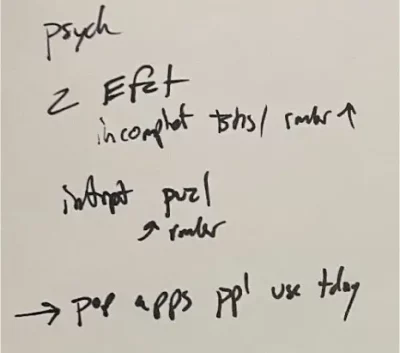
I know you probably can’t read my notes, so let me write them out below:
- psychology
- The Zeigarnik Effect
- incomplete tasks
- remember more
- Next, popular apps people use today
The academic talk passages always start with directions that state the class, which is why I wrote “psychology”.
Of course, while listening, I have no idea how to spell Zeigarnik, so I just wrote down “Z” in my notes. Your notes are for you, so don’t worry about spelling.
After that, I wrote down the definition and a few points I think might be important. I also wrote down what the professor plans to discuss next.
Notice how words are misspelled, and sentences are incomplete. There are also symbols like arrows to connect ideas. Your notes are just to trigger your memory, nothing more.
Try writing a few notes next time you listen, no more than 10 words. See if it helps you answer the questions after the academic talk.
And let me know in the comments if it does.
Tip #8: Be an active listener
Active listening is listening with a goal in mind. Most TOEFL test-takers are passive listeners. They listen and try to understand every word. This is the wrong approach.
Why?
When you try to understand every word, all the information presented is equal. No word is more important than the other.
In the TOEFL Listening passages, this is not the case. There are pieces of information that are crucial, like the topic of the talk, while other parts are not needed to answer the questions.
Active listening will put you in a better position to note down important information and answer the questions correctly.
When you listen to the academic talk, have three simple active listening goals:
- Identify the topic in the first 30 seconds
- Identify how the professor elaborates on the topic
- Identify what will come after the passage (if mentioned)
When you listen to a conversation, active listening goals:
- Identify the situation
- Identify the plan or solution
When you listen to an announcement, have two active listening goals:
- Identify why the speaker is talking (purpose)
- Identify what the listeners should do (suggestions)
Listening with these goals in mind will help you find the information you need to answer the questions.
Tip #9: Track your study progress
By keeping track of your progress, you can evaluate where you are and how much further you need to go. Also, this is a great way to remind yourself of how much you’ve already done!
Why do you think people who are trying to lose weight step on the scale?
They want to track their progress. Seeing that you lost a couple of pounds is a great way to stay motivated. If you don’t feel like you are improving, you are going to lose motivation.
Tracking your progress on the TOEFL is a bit trickier than measuring your weight. Here’s an example of what you could do for the TOEFL Listening. Let’s say you do the Listening section in TST Prep test #1 and score a 3.5/6
Write that down along with the date.
Take the same test again two weeks later. Compare your score and reflect on what you have learned.
If you notice a positive trend in your scores, use that to remind yourself that you can do this! Sometimes you feel like you’ve reached a plateau when studying for a big test like the TOEFL, but with a little reminder of how much you’ve already accomplished, you will gain extra motivation to keep studying and push forward.
Tip #10: Don’t panic
As test day approaches, nerves will creep into your mind.
It’s natural.
There is no way to avoid feeling nervous, so the first step is to accept that you will be a bit scared when you take the test.
And that’s great.
Fear is a good indicator that you are doing something meaningful. But you want to manage that fear and minimize it.
So, how do you do it?
First, a few days before the test, do NOT do anything new. This includes taking more practice exams. Although taking a practice exam may seem like a good idea, if you end up with a “bad” score, you will start to panic. Instead, take tests you have already done, review your notes, and refresh your memory of what you’ve already learned.
Avoiding new materials a few days before your TOEFL exam will help build your confidence. Here are some more tips to help you feel less stressed on test day:
- Get a good night’s sleep
- Take deep breaths
- Stretch
- And, most importantly, remember that your family, friends, and health are much more important than a test score!
Conclusion
Phew! That was a lot.
Since you’re still here, that means you’re serious about doing well, which is why we think you should download our 100 Practice Questions for the TOEFL Listening Section
There’s nothing worse than showing up to the exam center and wishing you had practiced more!
Did I miss anything? (or just want to say thanks!)
Let me know in the comments section below.
Don’t hesitate to reach out and let us know if you have any questions at contact@tstprep.com
Happy studies!






32 Comments
Marina
This tips are really good! They’ ve helped me a lot.
thanks very much!
Josh
Thanks for the comment Marina! Much appreciated 🙂
Don’t hesitate to let us know if you have any other questions!
Md Mahmud Hasan
Thank you Josh for giving such details and useful tips for listening . You provide here some unique tips which are really awesome.
Josh
Thanks for noticing! It took a lot of work so I appreciate you noticing 🙂
Vivian M Rodriguez
Phew! That was a lot of useful information.
Very precise and concise.
I also follow your videos on YouTube. They are quite interesting.
A big thanks.
Josh
Hi Vivian and thanks for taking the time to leave a comment, and such a nice one! Happy to help 🙂
Bosire Anyona
What a lesson! Thanks alot JOSH! I have followed and understood the flow of the content. Simple and clear just like a session in class.
Josh
Thank you! I appreciate it 🙂
Ana Karenina Sanchéz Villalobos
Thank you very much for this tips. They have help me a lot. I’ll put them in practice.
Josh
Good to hear and happy to help Ana!
Shakiba
Josh you’re the best, I’ve seen all your YouTube videos.
You’re so funny and your tips are just amazing. My test is in a month (I hope Corona virus gives me more days though). So thank you SO MUCH. Oh and your writing template is a life savor, love you 😡
Josh
Thank you so much for your kind words! Stay safe out there. Hopefully, this all passes soon 🙂
Keren
Thank you so much for this help Sir Josh
Be blessed
Josh
Thanks, Keren! Much appreciated 🙂
Mahbob
Thank you so much for the tips Josh, appreciated. Will be glad if you have such tip to improve reading of TOEFL.
Josh
Hi Mahbob and thanks for commenting! You can always check out our Ten Awesome TOEFL Reading Tips – https://tstprep.com/ten-awesome-toefl-reading-tips/
Carla E.
Thank you all so much for the tips!!!
Josh
Thank you for the support Carla 🙂
Ali
thank appreciate tst prep team. my major problem in this part is getting lost sometimes and i don’t hear some details when i face questions what is solution?
Josh
Hi Ali and thank you for your question. This is a pretty general question so it is hard for me to give any helpful advice. When you have a problem try to make it specific. For example, maybe you have trouble answering vocabulary questions in the TOEFL Reading. Once you make it specific, try to come up with some solutions to your problem or ask a teacher for some guidance.
This is the best way to overcome any TOEFL-related challenge. I hope that helps!
Aaliyah
Josh MacPherson…first of all, I congratulate you on being such a wonderful teacher. You definitely know your subject very well. I can’t thank you enough for providing such amazing content. It is lucid, specific, and well structured. Your videos clear major doubts and above all crashes” TOEFL Phobia”. It gives a head start to a student and then prepares him/her in a planned manner for the exam. You perfectly fit into one of the quotes, “The teacher who is indeed wise does not bid you to enter the house of his wisdom but rather leads you to the threshold of your mind… (Khalil Gibran).
Josh
Wow, thank you so much for leaving such a kind and considerate comment. It’s rare to read something so nice. Thank you for taking the time to write that. It really means a lot. However, you did all the work! You should congratulate yourself on working so hard and learning about all this TOEFL stuff. It’s not a very exciting topic ;).
Alaa
WOW, what great content. They were great tips honestly. Thanks from heart, I really appreciate your great work and I really benefited from them. Thanks a lot, teacher you really deserve a big clap.
Josh
Thank you so much for the comment, Alaa. Let me know if there is any other way I can help.
Cijie Zhang
Thanks for your tips, especially the “Be an active listener”. But I also have some problems of “Understand the passage structure like a professor”, I don’t know how to identify the structure at once, and how to deal with each structure (the same problem also in answer type, I don’t know how to answer each type). Do you have any further suggestions?
Finally, thanks for your help with the articles and videos.
Josh
Hi there and thank you for your questions. I do give advice on all of the issues you mentioned, but it is a bit difficult to explain in a comment, which is why I created the TOEFL Score Builder Course with videos explaining all of these ideas. I will leave a link here to it – https://tstprep.com/store/toefl-score-builder-program/
Ahmed
very good
Josh
Thank you for commenting!
Josh
Thank you for your feedback!
Nurbek
Thank you so much! Really awesome!
Josh
Thanks for the comment and good luck in your studies!
Josh
Thanks for the comment and happy to help 🙂