



EN | PT
Free Practice Test for the TOEFL® (PDF)

But wait!
Do you know what the updated TOEFL test actually looks like?
Learning a little bit about the new TOEFL iBT will go a LONG way.
By the end of this short article, you will know exactly what to expect in the TOEFL Reading, Listening, Writing, andSpeaking sections of the test.
In other words, you will learn exactly what to expect from each section of the TOEFL test:
- The TOEFL Reading Section
- The TOEFL Listening Section
- The TOEFL Writing Section
- The TOEFL Speaking Section
The TOEFL Reading Section
The first part of the exam is the TOEFL Reading section. This section of the TOEFL iBT test is adaptive, which means it will get easier or more difficult depending on your performance.
As of the latest TOEFL update on January 21, 2026, there are three types of tasks: Complete the Words, Read in Daily Life, and Read an Academic Passage.
| Test Section | Task type | Number of items | Approx. Base Time |
| Reading |
|
50 | 30 |
| Listening |
|
47 | 29 |
| Writing |
|
12 | 23 |
| Speaking |
|
11 | 8 |
For more information about the TOEFL Reading section, check out this post by Professional ESL Test Prep
Complete the Words
The number of Complete the Words tasks varies depending on the test, but expect between 2 to 3 on test day. For this task, you will be provided with an academic text between 70 to 100 words, and you will be required to fill in the blanks and complete the missing words.
Fill in the missing letters in the paragraph.
Read in Daily Life
This is the most common task type. Expect between 2-5 Daily Life tasks on test day. What makes this task type even more confusing is that there are three styles of tasks: Daily Life Short, Daily Life Long, and Text Chain.
Daily Life Short
As the name implies, this reading task is a bit shorter than the others. Daily Life Short passages are just a few sentences long, about 70 words on average, and usually come in the form of an announcement or an email.
Your job is to read carefully and answer two questions about the passage.
Read an email.
| Subject: | Textbook Collection Reminder |
|
Dear Students, If you rented textbooks this semester, please return them to the campus bookstore by December 18. Late returns will result in a small fine. Students who have lost a book should email the bookstore for instructions before the deadline. Best, |
|
What will happen if students return their books after December 18?- Their grades may be affected.
- They will lose the right to rent again.
- They must pay the full price of the book.
- They will receive a fine.
- What can be inferred about the bookstore’s policy?
- It has not experienced a late return before.
- It allows communication before the deadline.
- It rents books and does not sell them outright.
- It will be closed after December 18th for the holiday season.
*Answers at the end of the article
Daily Life Long
Daily Life Long passages are just longer versions of Daily Life Short. You can expect to encounter it in either email or announcement format. Emails are much more common. The passages are usually about 150 words, and you must answer three questions.
Read an email.
| Subject: | Invitation to Join the Academic Mentorship Program |
|
Dear Students, We are pleased to announce the launch of the university’s Academic Mentorship Program for the upcoming semester. The initiative pairs first-year students with experienced upper-class mentors who can offer guidance on study strategies, time management, and adjusting to campus life. If you are interested in becoming a mentor, please complete the short application form on the Student Success Center website by February 14. Training sessions for selected mentors will take place during the last week of February. Participants will receive volunteer-hour certificates and a letter of recognition from the Dean’s Office. This program has helped hundreds of students feel more connected and confident in their academic journey. We encourage you to get involved and make a positive difference in someone else’s experience. Warm regards, |
|
- What is the main purpose of the email?
- To request feedback on past mentoring experiences
- To announce a new scholarship opportunity for first-year students
- To provide information about tutoring services at the Student Success Center
- To invite students to participate in a university mentorship program
- When will training sessions take place?
- By the end of the spring semester
- Around February 24th
- During the first week of February
- By February 14
- What can be inferred about the program’s previous success?
- It has mainly focused on graduate student mentorship.
- It was recently introduced and still being tested.
- It has been in place for several semesters.
- It has faced difficulties recruiting interested applicants.
Text Chain
You probably will not see this task type on test day. It is rare, but it may still come up, so it is worth mentioning. The Text Chain passage is, well, a text chain. It is designed to emulate the type of correspondence you would find in a work chat on a site like Slack or in a group chat in an app like WhatsApp. Same as the Daily Life Long task, you will be expected to answer three questions based on the text.
Read a text chain.
Priya Singh (2:00 P.M.) Hi everyone, just a reminder that the volunteer schedule for Saturday’s campus open-house event needs to be finalized today.
Jun Kim (2:04 P.M.) I’ve already confirmed the morning shift with three students from the debate club.
Mimi Chen (2:06 P.M.) Great! I’ll handle the afternoon shift sign-ups. Should I assign two people to each information table again?
Priya Singh (2:08 P.M.) Yes, please. Also, make sure one volunteer at each table knows how to log visitor check-ins on the tablet.
Marco Mercado (2:10 P.M.) I can run a quick demo session tomorrow morning to show everyone how the app works.
Priya Singh (2:12 P.M.) Perfect, Marco. That should prevent the confusion we had at last semester’s event. Thanks, everyone.
- What is the main purpose of the messages?
- To assign volunteers for a campus event
- To choose a location for the open house
- To invite students to volunteer for an open house event
- To announce a change to the volunteering participants
- What can be inferred about last semester’s event?
- The app training took too long
- The visitor check-in system did not work smoothly
- There were not enough volunteers available
- Few visitors came to the event
- According to the messages, who will demonstrate how to use the check-in app?
- Mimi
- Jun
- Marco
- Priya
Read an Academic Passage
The longest task type is Read an Academic Passage. The texts are about 200 words long, followed by five questions. Expect the reading to be an academic topic, the type you would find in a freshman-level university course in North America. While it is impossible to predict what topic you will encounter on test day, ETS states, “The passages cover topics drawn from subject areas such as history, art and music, business and economics, life science, physical science, and social science.”
No matter what the topic, don’t worry if you have never heard of it before. Everything you need to answer all the questions is provided in the text. There will be between one to three academic passages on test day.
The Rise of the Telegraph
Before the nineteenth century, communication could travel only as fast as a messenger on horseback or a ship at sea. News, orders, and personal letters often took weeks or months to reach their destinations. That changed dramatically with the invention of the telegraph. Using electric signals sent through wires, people could transmit messages across vast distances in seconds, transforming both business and daily life.
The first major network was developed in the 1840s by Samuel Morse in the United States. His system converted words into patterns of short and long electrical pulses, known as Morse code. Telegraph offices soon lined railroad stations, allowing traders to track prices and newspapers to report events almost as they happened. During the American Civil War, generals used the telegraph to coordinate troop movements, demonstrating how information could become as decisive as weaponry. Similar systems spread across Europe and later under the oceans, connecting continents through submarine cables.
The telegraph compressed the world. It reshaped politics, commerce, and journalism by introducing the idea of instant communication. Though later replaced by telephones and the internet, the telegraph laid the first electronic foundation for the global networks that now link nearly every part of human society.
- All of the following are mentioned in the passage as effects of the telegraph EXCEPT —
- The spread of international communication
- Quicker reporting of news events
- Improvements in transportation speed
- Changes in political and commercial life
- The word “compressed” in the passage is closest in meaning to
- weakened
- shortened
- expanded
- delayed
- Why does the author mention Samuel Morse?
- To identify the inventor who developed the first large-scale telegraph network
- To compare his invention with earlier systems of long-distance communication
- To show how his work improved military technology
- To explain why his code was later replaced by the telephone
- What can be inferred about communication before the telegraph?
- It involved widespread use of coded signals.
- It was faster but less reliable than later systems.
- It relied entirely on transportation speed to deliver messages.
- It required coordination between countries through trade networks.
- What is the relationship between paragraphs 2 and 3?
- Paragraph 3 provides detailed examples of how Morse’s code was transmitted.
- Paragraph 3 contrasts the telegraph with newer communication inventions.
- Paragraph 3 introduces problems caused by the telegraph’s invention.
- Paragraph 3 explains the broader impact of the developments described in paragraph 2.
*Answers at the end of the article
Many students struggle to understand and answer the questions. For more on the TOEFL Reading question types, check out our article ”10 Awesome Tips for the TOEFL Reading.”
The TOEFL Listening Section
The updated version of the TOEFL test now includes four different types of tasks for the TOEFL Listening. Some are short, no more than a sentence-long, and others are long, lasting nearly two minutes.
While the previous exam focused solely on listening passages that take place on campus and in the classroom, tasks now include situations you would encounter in everyday life outside the school setting.
Confused?
Don’t worry, I’m going to show an example of each of the four new task types:
- Listen and Choose a Response
- Listen to a Conversation
- Listen to an Announcement
- Listen to an Academic Talk
Listen and Choose a Response
The first task you will see in the TOEFL Listening section on test day is Listen and Choose. You will listen to a question or statement and have to pick the best response.
Sounds easy, right?
Well, kind of.
Sometimes, the statements are simple questions, like this one, “Did you get a chance to talk to the professor?”

*Answers at the end of the article
Unfortunately, most Listen and Choose questions are a bit trickier. The statements often take the form of statements with an implied message and your job is to figure out which response works best given the situation. In this example, the speaker says, “I just got back from the dentist.”

*Answers at the end of the article
Listen to a Conversation
Listen to a conversation.

- Why does the man mention double-checking their flight times?
- He plans to change the time of departure so they can arrive earlier.
- He forgot to confirm the flight details earlier.
- He wants to ensure they can pick up the car on time.
- He thinks the rental location might close early.
- What does the man suggest the woman do?
- Take care of booking the rental car
- Wait until they arrive to rent a car
- Call the airline to verify their schedule
- Pay for the hotel instead of the vehicle
Listen to an Announcement
Announcements are similar in length to conversations. In fact, they are a bit shorter, anywhere between 15 to 40 seconds. There is just one speaker, and the context is almost always on a North American campus. The speaker will announce a change on campus and provide a few details about it. “The announcement may include information about schedules, directions, rules and regulations, or student achievements.”
Listen to an announcement at a university event.

NOTE TO STUDENT: On test day, you can not see the questions until after you listen.
- What is the main purpose of the announcement?
- To announce new requirements for grant applications
- To inform students about a financial aid information session
- To advertise a workshop on budget management
- To remind students to check their financial aid status
- Why does the speaker mention Friday at 10 a.m.?
- To specify the time and date of the information session
- To clarify the deadline for submitting financial forms
- To announce when financial aid offices will close
- To remind students about weekly office hours
*Answers at the end of the article
Announcement Transcript (NOT available on test day) Listen to an announcement at a university event. Good morning, students. The Financial Aid Office will host an information session this Friday at 10 a.m. in Room 202. Staff members will explain how to complete renewal applications and answer questions about scholarships and grants for next year. Students are encouraged to bring their laptops if they want help submitting forms online.Listen to an Academic Talk
The Academic Talk task is similar to previous generations of the TOEFL exam. It consists of an academic talk on the type of topic you would expect to hear in a freshman-level class at university. Except that this version is much shorter, lasting about 90 seconds. You may take notes if you would like.
But don’t worry if you know nothing about the topic.
Remember, this is an English exam, not a biology, psychology, or any other domain-specific exam. The TOEFL is an English proficiency exam. All the information you need to answer the four questions will be provided in the audio.

NOTE TO STUDENT: On test day, you can not see the questions until after you listen.
-
What is the main topic of the talk?
- The role of attention and focus in modern productivity methods
- A psychological phenomenon related to unfinished tasks
- How memory retention varies between short-term and long-term recall
- Early twentieth-century experiments that shaped the field of cognitive science
- According to the speaker, what did Zeigarnik observe about waiters in a cafe?
- They performed better when they tracked multiple tables simultaneously.
- They remembered unpaid orders better than completed ones.
- They relied on repetition rather than reasoning to recall customer requests.
- They retained details longer when the café was quiet and less crowded.
- What can be inferred about unfinished tasks according to the speaker?
- They are more memorable because people consciously choose to revisit them.
- They often strengthen unrelated cognitive skills.
- They tend to occupy the mind until they are completed.
- They typically cause the brain to block other incoming information.
- What will the speaker most likely discuss next?
- Modern tools and techniques designed to help people stay focused
- The origins of psychological research in early twentieth-century Europe
- The relationship between memory and physical health in older adults
- The use of experimental methods in unrelated areas of psychology
*Answers at the end of the article
Academic Talk Transcript (NOT available on test day)
Listen to a talk in a psychology class.
The Zeigarnik Effect refers to the human tendency to remember unfinished tasks more vividly than completed ones. The concept originated in the 1920s when psychologist Bluma Zeigarnik noticed that waiters in a café recalled unpaid orders with remarkable accuracy but quickly forgot them once the bills were settled. She reasoned that incomplete tasks create a mild state of psychological tension that keeps them active in memory until closure is achieved.
Subsequent studies have supported this finding. In one experiment, participants who were interrupted midway through solving puzzles remembered the details better than those who finished without interruption. Their minds appeared to keep the unresolved task “open,” as if waiting for completion. Modern researchers link this to goal-oriented cognition: when a goal remains incomplete, the brain maintains heightened focus on related information.
The Zeigarnik Effect helps explain why people replay unfinished conversations or feel compelled to check incomplete work. It also suggests practical strategies for productivity, such as breaking large projects into smaller segments that preserve motivation. Next, let’s take a look at some popular apps and inventions that people use today to improve their focus and reduce the impact of the Zeigarnik Effect.
The TOEFL Writing Section
As of January 21st, 2026, the TOEFL Writing section consists of three tasks.
- Build a Sentence
- Write an Email
- Write for an Academic Discussion
The last task, Write for an Academic Discussion, is the only surviving task from previous generations of the TOEFL iBT.
Each task type is unique, so it is important to understand what the TOEFL graders expect you to do on test day.
Build a Sentence
The first 10 questions in the TOEFL Writing section of the updated TOEFL iBT test are Build a Sentence. For each question, you will be given a statement or question, and you must arrange the given words and make a coherent response. You will have 5 minutes and 50 seconds to complete all ten items, which equates to 35 seconds per question.
There will be between 6 to 8 blanks that must be filled. The given words are sometimes lumped together as phrases. In the example below, you should drag and drop the words to create the sentence, “He explained where we’d be stopping for lunch.”

What did the tour guide mention at the start of the trip?

.
Notice that the phrase “was going” was not used in the answer. Sometimes, you will be given extra words or phrases that will not be needed.
You may not always need to respond to a question, either. Sometimes, the given part is a statement and you must formulate a question, like this example, “Did he tell you what company he’s working for?”

I heard Ethan started a new job last month.

Did he ?
If you are looking for advanced tips, tricks, and strategies for how to answer not just Build a Sentence, but every question on the TOEFL exam, check out our Score Builder for the TOEFL. It has everything you need to get the highest possible score on test day.
Write an Email
The second task in the TOEFL Writing section is called Write an Email. On test day, you will have seven minutes to read the prompt and write the email. Aim to write between 100 to 150 words and respond to all of the requirements outlined in the prompt.
There is no one set template for the Write an Email task because the requirements vary. While there is a general overall structure, there are some words or phrases that will not work all the time. Here is the general structure of the response:
- Greeting: Dear (name),
- Introduction: I hope you are doing well, and I apologize for disturbing you.
- Purpose: I’m writing to…
- Purpose explanation: You see…
- Request: Would it be possible…
- Closing: Thank you for reading.
WARNING: Again, this structure will not work 100% of the time, but it will most of the time.
You recently moved into a new apartment and discovered several maintenance issues that were not
mentioned in the lease…
Write an email to Mr. Hill. In your email, do the following:
- Describe the maintenance issues you have noticed.
- Explain how they are affecting your daily life.
- Request that they be repaired soon.
Write as much as you can and in complete sentences.
Your Response:
To: Mr. Hill
Subject: Request for apartment maintenance repairs
Space for typing answers. On test day, you will have 7 minutes to read and write.
Sample Answer #1
Dear Mr. Hill,
I hope you are doing well, and I apologize for disturbing you. As you know, I moved into your apartment on Highwood Street last week. I’m writing to mention a few maintenance issues that I’ve noticed since then. Recently, the faucet in the bathroom sink has a steady leak that I cannot stop. I can hear this leak during the night, and it is interrupting my sleep. I’m also worried about wasting water. In addition, the doorbell on the front door does not work. This makes it difficult to receive packages from delivery drivers, since they have no way of letting me know that they have arrived. Would it be possible for you to arrange repairs for both of these issues right away? I will be at home all week, so I can easily let you in no matter when you arrive to take care of them.
Thank you for reading,
Zorica Hedlund
For more on this, you can download Your Guide to the TOEFL Writing ebook for free right here.
Write for an Academic Discussion
The third and final task in the TOEFL Writing section is Write for an Academic Discussion. The task is meant to mirror the type of situation you might encounter in an online learning environment. The teacher poses a question, two students provide their opinions, and your job is to add to the discussion.
The topic will be something you would expect to be asked about in a freshman-level class in a North American university.
Your professor is teaching a class on political science. Write a post responding to the professor’s question.
In your response, you should do the following.- Express and support your opinion.
- Make a contribution to the discussion in your own words.
An effective response will contain at least 100 words.

Dr. Williams
We’ve been discussing the concept of globalization in class, and today I’d like to ask you a question related to that topic. Some people argue that globalization is beneficial to everyone because it creates more opportunities for trade, travel, and cultural exchange. Others believe that it has negative effects on developing countries and on the environment. What do you think? Is globalization a positive or negative force in the world today?

Bryan
I think that globalization is a positive force overall because it brings people and cultures closer together. Trade and travel allow people to learn about different parts of the world and different ways of life. Also, globalization can bring economic benefits to developing countries, such as access to new markets and new technologies. However, I do agree that we need to be careful to minimize the negative environmental impacts of globalization.

Alex
I disagree with Bryan. I think that globalization has negative impacts on developing countries. Globalization can lead to exploitation of workers and resources in developing countries by more powerful corporations and countries. Also, globalization can lead to cultural homogenization, where local cultures are lost in the pursuit of global uniformity. So, I believe that globalization needs to be balanced with policies that promote fairness and respect for local cultures and environments.
Space for typing answers on test day. You will have ten minutes to read and write.
Sample Answer
In my opinion, globalization is a positive force in the world today. My personal belief is that when nations interact together, it leads to less suffering. For example, people who suffer from natural catastrophes can import goods and services to help mitigate their losses and recover quickly. Citizens of nations who may be going through war or famine can flee to neighboring countries for shelter. While Alex raised a relevant point about cultural homogenization, I believe he is missing a critical point. To be more specific, much of the food found in grocery stores around the world is imported. Our very diet is due to the international trade partnerships and alliances forged over the last half of the 20th century. International trade and travel are not possible in a world without globalization, which is why it is crucial to maintain our current global policies for a safer world with a higher standard of living. (154 words)
If you are curious to know more about how the TOEFL Writing is graded, check out the grading rubrics on ETS’ official website available here.
The TOEFL Speaking Section
The last section of the updated TOEFL iBT is the TOEFL Speaking. This might surprise some TOEFL old-timers, because in the past, Writing was the last section of the exam.
Not anymore.
In the TOEFL Speaking, there are just two tasks:
- Listen and Repeat
- Take an Interview
If that sounds short, well, it is. It should take you less than 10 minutes to complete the TOEFL Speaking. Here is what you will have to do on test day.
Listen and Repeat
The first task in the TOEFL Speaking is Listen and Repeat. It starts with an image and some directions. The directions will provide context about the image and the situation.
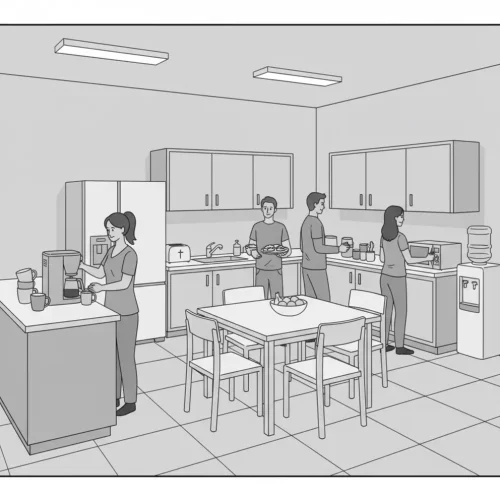
After the directions, you will be tasked to repeat seven statements. The statements will come one at a time and somehow connect with the image provided. Your job is to repeat each statement clearly, accurately, and naturally.
The first few statements are shorter and easier.
You are welcoming new employees to the office kitchen. Listen to the speaker and repeat what they say. Repeat only once.
Welcome to our office kitchen and break area.
You can store your lunch inside the refrigerator.
Please label your food so everyone knows who it belongs to.
As you progress, the statements will get longer and more complicated.
You are welcoming new employees to the office kitchen. Listen to the speaker and repeat what they say. Repeat only once.
Welcome to our office kitchen and break area.
You can store your lunch inside the refrigerator.
Please label your food so everyone knows who it belongs to.
The coffee maker and microwave are available for everyone to use.
Remember to clean up after yourself and leave the counters tidy.
We keep extra cups and utensils in the cabinets above the sink.
At the end of the day, check that all appliances are turned off and the trash has been taken out.
You will have between 8 to 12 seconds to repeat each statement. You only get one chance to repeat what you heard; that’s it. Once you finish all seven statements in Listen and Repeat, you will move on to the interview portion of the TOEFL Speaking.
Take an Interview
- Lifestyle: sports, hobbies, exercise
- Habits: travel, dietary, technology
- Education: study habits, learning style
- Social: spending time with friends, shared routines
This will be followed by the first question. After the question is read, you will have 45 seconds to respond. Note that once the speaker is finished reading the question, the timer will start immediately. You will have no time to prepare. Zero.
As soon as the question is done, the timer starts.

Question #1 (You can NOT see the audio transcript on test day)
“Thank you for speaking with me. Let’s begin with something simple. Have you worked on any group projects at school? What kind of tasks did your group have to complete? For example, did you have to create a presentation, do research, or give a speech?”
Sample Answer #1
Yes, I’ve done several group projects, but the one that stands out was in my second-year mechanical design class, which was kind of like a robotics class, basically. My team had to build a small robot that could follow a line on the ground and avoid things on the floor. I was in charge of programming the sensors, while others worked on the frame and the wiring. We spent weeks in the lab testing and fixing things that didn’t work. In the end, our robot actually won second place in a campus competition, which felt amazing. That project taught me how much communication and patience matter when people have different ideas but share the same goal.
After that, you will have three more questions expanding on the topic, so four questions in total. You must speak for up to 45 seconds for each question.
Question #2 (You can NOT see the audio transcript on test day)
“That sounds interesting. When you work in a group, do you prefer to take the lead or follow directions from others? Why?”
Sample Answer #2
Hmm, that’s a good question. I guess I usually prefer to take the lead when I work in a group. It’s not because I want control, but I like organizing things and making sure everyone knows what to do. When no one takes charge, people end up talking in circles and nothing gets done. During my robot project at university, for example, everyone had strong opinions about the design, and it started to get messy. I decided to step up and make a schedule that divided the work fairly. After that, things finally started to move forward. I don’t mind listening to different opinions, but I’ve learned that sometimes someone just has to take charge so the team can make progress.
Question #3 (You can NOT see the audio transcript on test day)
“I see. Many universities encourage teamwork to prepare students for professional life. Do you think group projects will become even more common in education in the future? Why or why not?”
Sample Answer #3
Yes, I think they definitely will. In almost every job these days, you have to work with other people, so universities are trying to help students build those skills early. In my department, group work used to be limited to a few classes, but now almost every course has at least one project that requires teamwork. I think it makes sense, because technology is making work more connected. I learned in one of my classes last semester that engineers in different countries can work on the same design through shared software, so being able to communicate and cooperate is essential. Even though group projects can be frustrating sometimes, they prepare you for what real workplaces are like.
Question #4 (You can NOT see the audio transcript on test day)
“That’s a good point. Finally, some people believe teamwork helps people develop communication skills. Do you agree with this idea, or do you feel teamwork slows down individual progress? Explain why you think so.”
Sample Answer #4
I completely agree that teamwork improves communication skills. When I first started university, I wasn’t very comfortable speaking in English during group discussions. I was always worried about making a mistake or sounding stupid, but working with classmates changed that. In one project, I had to explain my code to an exchange student from Germany who didn’t understand Korean, so I had to find simple words and be patient. Over time, we got to know each other and became good friends because we had the shared experience of lacking confidence in English. It’s funny, actually, that shared insecurity made it even more fun to communicate. I still like working alone sometimes, but I know that without teamwork, I wouldn’t have learned how to work through difficult times.
If you are curious to know more about how the TOEFL Speaking is graded, check out the grading rubrics on ETS’ official website available here.
And that, in a nutshell, is the test! If you made it this far, you are probably ready to take a practice test, which you can do right here.
Or maybe you are looking for a couple of quick tips before you start. If so, keep reading. These five tips will help maximize your score.
Five Tips to Improve Your Score
I know, I know, you are in a hurry to take a TOEFL practice test.
Just give me two minutes.
These five TOEFL tips can help dramatically improve your score.
Tip #1: Get Used to the Clock
Each section of the TOEFL iBT is timed. In the Writing section, Build a Sentence provides just 5 minutes and 50 seconds to answer all the questions. In the TOEFL Speaking, you only have 45 seconds to answer a Take an Interview question.
Getting used to the time is crucial.
Some students forget to practice with a clock and run out of time on test day. Or worse, they get scared when they see the seconds tick down in the top right of the test screen.
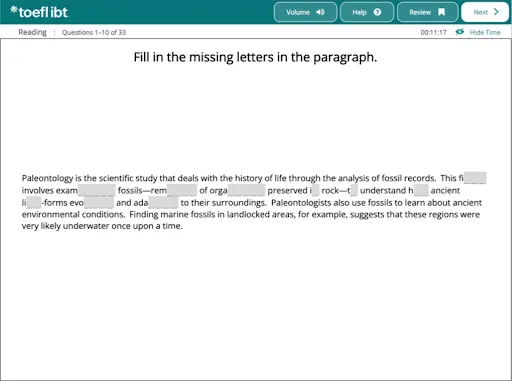
When studying at home, always practice under the test time constraints. This will prepare you to work under pressure and manage your time on test day.
Tip #2: Type Without Spellcheck
Tip #3: Explain Your Answers
Tip #4: Record Your Voice
- ✅ ❌ Did I include less than three fillers (uh, um, you know)?
- ✅ ❌ Did I stay on topic and answer the question?
- ✅ ❌ Did I avoid hesitating or repeating more than two separate times?
- ✅ ❌ Did I speak for at least 42 seconds?
- ✅ ❌ Did I use at least two transitional words or phrases?
- ✅ ❌ Did I elaborate on the topic with a well-developed personal example, anecdote, or explanation?
- ✅ ❌ Did I provide a response at least 110 words long?
- ✅ ❌ Did I include at least one strong phrase, idiom, or expression?
- ✅ ❌ Did I speak at a natural pace, not too fast or slow?
- ✅ ❌ Did I speak clearly enough to be easily understood? (check with speech-to-text software)
*What can I do better next time?
This checklist for Take an Interview is really going to help identify your weaknesses and learn how to improve. Record your voice and use the checklist.
Tip #5: Plan on Sunday
If you are reading these words right now, you are probably studying on your own. Doing it on your own is empowering, but challenging. You must be responsible for not only studying, but setting up your study schedule. It is very easy to get lazy or lose time by scouring the internet for practice materials.
Make your life easier by planning out your TOEFL studies for the week on Sunday. Organize the tests, videos, and practice questions you would like to focus on each day. This will help save precious time. So many students end up losing minutes, even hours, just thinking about what they will focus on for the day. Don’t fall into this trap. Plan your week on Sunday.
All right, that’s enough talk out of me. I’m sure you are ready to take a TOEFL Practice test. Follow the link here to start.
Before you go, let me know what you think in the comments below. What did you find most helpful? Did I miss anything?
Leaving a comment helps me learn more and helps the site grow.
If you have any questions, we are always here to help: contact@tstprep.com
Answer Keys
Complete the Words
Daily Life Short
Daily Life Long
Text Chain
6. A
A is correct because the entire exchange revolves around confirming and assigning volunteers for the campus open-house event. Priya organizes shifts, Jun confirms his group, and Marco volunteers to train others. Option B is incorrect because they already have a location.. Option C is wrong because no one is inviting new volunteers. Option D is also incorrect since the team isn’t changing participants, just finalizing plans.
7. B
B is correct because Priya says Marco’s demo “should prevent the confusion we had at last semester’s event,” implying that the visitor check-in system didn’t run smoothly last time. Option A is incorrect; there’s no sign the training was too long. Option C is unsupported. Everyone seems to have enough help. Option D is false because the issue was confusion, not low attendance.
8. C
C is correct because Marco explicitly says, “I can run a quick demo session tomorrow morning to show everyone how the app works.” Option A is incorrect. Mimi manages sign-ups, not training. Option B is wrong since Jun only confirmed volunteers. Option D is incorrect because Priya oversees coordination but doesn’t handle app demonstrations.
Read an Academic Passage
9. C
C is correct because improvements in transportation speed are not discussed as an effect of the telegraph. The passage describes faster communication, political and commercial changes, and international connections, but it never claims that transportation itself became faster.
10. B
B is correct because “compressed” in this context means shortened or made smaller. The author writes that “the telegraph compressed the world,” referring to how it reduced the time needed to share information. Weakened and delayed express the opposite meaning, and expanded does not fit the idea of bringing distances closer.
11. A
A is correct because Samuel Morse is introduced as the inventor who created the first major telegraph network in the 1840s. The passage credits him for developing Morse code and explains how his system transformed communication. The remaining options misrepresent the author’s intent, as the text does not compare, replace, or limit his contribution.
12. C
C is correct because the first paragraph makes it clear that before the telegraph, messages traveled only as fast as physical transportation allowed, whether by horse or ship. The other options are inaccurate since there is no mention of coded systems, higher reliability, or international coordination at that stage.
13. D
D is correct because the third paragraph expands on the developments described earlier, explaining how the telegraph’s invention influenced politics, business, and daily life. The new paragraph shifts from historical detail to overall impact. The other options do not fit since there are no transmission examples, contrasts with newer inventions, or major problems described.
Listen and Choose a Response
1. A, Yes, she answered all my questions after class.
A is correct because it directly answers the question and provides relevant detail about what was discussed. The other responses fail to address the question or shift topics. Option d could fit, but a certainly fits, making a the better answer. Option d brings up the idea of checking a syllabus, and that is never mentioned or alluded to.
2. A, I hope it went well.
A is correct because it’s a polite and natural response to someone mentioning a dentist visit. The others are overly factual or off-topic.
Listen to a Conversation
3. C
The man says he will double-check their flight times “so we can make sure we get to the rental car place on time.” This shows that he wants to confirm the schedule to avoid missing the pickup window. Option A is incorrect because there’s no indication he plans to change the flight. Option B is wrong since he never mentions forgetting. Option D doesn’t fit because he expresses concern about timing, not business hours.
4. A
The man suggests that the woman handle booking the rental car. He says, “I’ll cover the hotel if you handle the car,” clearly dividing the responsibilities. Option B is incorrect because they plan to rent ahead of time. Option C is wrong since he never asks her to contact the airline. Option D doesn’t fit because he offers to pay for the hotel himself, not the other way around.
Listen to an Announcement
5. B
The announcement is meant to inform students about the financial aid information session. The speaker states the date, time, and purpose—to help students with renewals and scholarships. The other options are unrelated to the actual content of the session.
6. A
Friday at 10 a.m. is mentioned to identify when and where the information session will occur. It is not a deadline or office hour reference. The other options suggest unrelated times or administrative purposes.
Listen to an Academic Talk
7. B
Everything centers on why unfinished tasks linger in memory and how that tension keeps goals active. Option A broadens the topic to attention generally. Options C and D miss the focus by shifting to memory systems or the history of the field.
8. B
Zeigarnik noticed waiters retained unpaid orders but quickly forgot settled ones, which launched the idea. Options A and D add performance and crowding claims that are absent. Option C invents a strategy the talk never mentions.
9. C
The implication is that incomplete goals keep the mind engaged until closure, so they continue to occupy attention. Option A overstates conscious choice. Options B and D describe effects the lecture does not claim.
10. A
The final sentence points forward to apps and methods that support focus, so the next topic is modern tools. The other options shift to unrelated periods or themes not queued by the transition.

Complete Practice Test #13
Did you find these TOEFL tips helpful? Is there another TOEFL tip you believe is useful? Let us know in the comments section below. And we are always here to help if you have any questions: contact@tstprep.com




134 Comments
Peak Academy
Best Introduction regarding basic four sections of TOEFL test.
Keep It Up ….!
Josh
Wow! Nice compliment and much appreciated Peak Academy. We will keep working. Let me know if there’s anything you would like to see in particular.
Binyam Ayele
Hi josh first I want to thanks you for your support my question is how can I contact you on social media to be in touch and ask questions like on face book or telegram and my other question is how can I douloud all sections of tofle practice tests
Josh
Hi Binyam and thanks for asking. I try to respond to comments on our TST Prep (like right now) and on Youtube – https://www.youtube.com/toeflspeakingteacher1.
We also have a support staff that you can always reach out to at contact@tstprep.com.
Hope that answers your question.
John
This is so valuable – a great breakdown of the exam from one of the best in the business! Thank you Josh!
Josh
Ha, thank you John. I do really appreciate that 😉
Tanya
thank you 🙂
Leonardo
Thank you so much for these materials, they were a life saver !!
Josh
That’s great to hear Leonardo! Let me know if there’s any other way we can help 😉
Najibullah Naziry
So practical thank you so much.
Josh
Thank you for the kind comment 🙂 It really helps us when students like you confirm the quality of our materials. Thanks again!
Suncana
Some of the information on this website is contrary to the official toefl book info, especially regarding the number of words in written parts, which cofuses me. Why’s that?
Josh
Excellent point Suncana. There’s an excellent and short article about this issue on TOEFL Resources at this link – https://www.toeflresources.com/news/question-how-long-should-a-toefl-essay-be – but here is a short quote which I believe answers your question,
“I am often asked how long the TOEFL essays should be. The quick answer to this is that an independent essay should be between 380 and 400 words, while an integrated essay should be between 280 and 300 words.Let me explain where these numbers come from. It is true that when you are looking at the screen at the test center, the TOEFL software will suggest that a “typical” essay is much shorter than what I have suggested above. I caution you that a “typical” essay should not be your target. A typical essay will score in the low twenties. If you want a higher score than that, you need to write more.” – Hope that helps!
Suncana
Thank you very much. I really appreciate your help
Best regards
Josh
No problem! 😉
Kelly
This test is such a practical 🙂 Also, i bought test packs so I can practice it everyday until my exam date. Thank u!
Josh
Thank you for your trust and support Kelly! I appreciate it. Don’t hesitate to let me know if you have any questions.
Azode Elvis
I really enjoy having this test because it brings out aspiration and motivation so I which to summit all my efforts to go far
Josh
That’s great! Good luck and let me know if you have any questions along the way.
Mohammed Almisbahy
Hi sir ….
I’m really appreciated that you allow us to understand the way of the test .
I wish you all the best
Josh
Thank you for your kind words! Happy to help 🙂
Joseph
I really appreciate this plateform, looks so practical, but i need your help to improve my speaking and writting.
Josh
Hi Joseph and I understand what you mean. Some students need more personalized feedback, especially for speaking and writing. If you check the TOEFL store you will see classes and evaluations for the speaking and writing. You might consider enrolling.
https://tstprep.com/toefl-store/
Either way, happy to hear you found the site helpful.
Josh
You’re welcome 🙂
Gulnar Albushova
Mr. Josh,
This website is perfect!!! After the superlearn.com shut down I felt hopeless about TOEFL. Thank you very much for regaining my hope again.
I am advertising your website everywhere!
Best of luck!
Josh
Wow, thank you for your kind words Gulnar. And we are new so spreading the word would be great. Let me know if there is any other way we can help.
Tamiris
This website is really helpful! I have been practicing a lot for my TOEFL test these days and this preparation will help me improve in Writing and Speaking section.
Nice job! Congratulations to the team.
Josh
Thank you for your kind words Tamiris. Let me know if there is anything else we can do to help.
Paola Merizalde
Hi Josh, I really appreciate the big efforts from you and your team in the success of the Toefl students. I have a question for you. It seems almost impossible to read the passages of the reading part, what would recommend us to do? thanks for any advice and suggestions.
Regards,
Paola M.
Josh
Hi Paola and thanks for the question. When you say “almost impossible to read the passages”, do you mean that you do not have enough time to read the passages and answer the questions at the same time? If that is the case, here is a guide to time management to the TOEFL Reading – https://tstprep.com/a-guide-to-toefl-reading-time-management/
Hope that answers your question.
Javier
Its good, excellent
Josh
Thanks Javier! Happy to help 🙂
Obaid Hamdard
Thank You Josh, with these wonderful and so much useful materials of TOEFL IBT.
Josh
Thank you for commenting Obaid. Happy to hear you found them helpful.
Barry Mamadou Mountagha
Thank you, the website seems to be interesting sir. What do you think about offline software preparation according to your experience? I have been using the since few weeks, but i have stopped cause i don’t know whether they followed ETS requirement. Thank you once more.
Josh
Hi Barry and good question. It depends on the company. Of course, I will always recommend our resources here at TST Prep, but anything from ETS itself is also good. those are the only two resources I trust with practice materials 😉
Nasratullah
Dear sir, I agree with him and it gonna be a really practical resource for all of us.
Silas Leprince
Hi sir ,i would like to know if is it possible to take that practice test offline.Thanks
Josh
The test is a downloadable PDF, so you can actually only take it offline. Hope that clarifies.
Elysee
this is really helpful.however,i would like to know about new TOEFL structure .
Josh
I understand Elysee. We are currently updating our tests and everything should be done by the end of September 2019. In the meantime, you may find this video I made helpful – https://youtu.be/fD-oAVSth6U
Tixxa Cassie
This website really helpful! I will visit everyday if there any updates. I’ll do my test on Nov this year. wml 🔥
Josh
Great to hear Cassie! Let me know if there is anything else we can do to help.
Ruszaimi
Dear Josh,
I am currently establishing small scale course of TOEFL Preparation’s in my neighborhood. I am targeting post-graduates as they will need TOEFL score as one of the academic requirement to pass. I am low in financing to buy complete TOEFL Book of Tests and Audios.I am deeply frustrate and need you to help me out with free sample of downloadable materials. Please consider.
I also can not afford internet in case of only online materials available.
Any solutions or suggestions.
Best Regards,
Josh
Hi there Ruszaimi and thank you for your comment. We have a lot of free materials on our site which include a free practice test. 200 reading and listening questions, 100 independent speaking questions and more. All you have to do is click the “free resources” tab on the top of the page and you will find it all there.
Besides that, our paid services are for students who pay. It would not be fair to everyone else if we were to share the materials for free with you that everyone else has paid for. I do hope you understand.
Thanks for commenting and good luck with your school!
Abu Noor
Josh: Your youtube videos are so helpful! Thank you so much great TOEFL teacher!
Josh
Such a nice comment! Thank you 🙂
Josh
No problem! Thanks for taking the time to leave a comment 🙂
Corlia Van Der Walt
I am feeling very anxious this morning. My test is this coming Saturday (28 September) and it feels like despite studying and reading a lot, I am not getting far! Is this normal? For instance the writing section, I have followed the tips on your website and your videos (keep it simple, don’t try to be smart) however if you read the high rated answers to the independent writing they sound very smart! This is confusing to me as I feel that a “simple” answer and sticking to facts might not be rated so high?
Josh
Hi Corlia and thank you for your question. For the speaking and writing sections, everyone performs at a different level and has their own strengths and weaknesses. It is hard for me to give specific advice to you in your situation without reading your writing. In general, when students try to “sound smart”, they tend to use vocabulary and grammar they don’t understand very well, and the graders can tell that the essay is awkward, hence my advice.
However, if you are comfortable writing in complex lexical and grammatical then try to sound smart! If you are still confused, I would suggest meeting a teacher or submitting an essay for evaluation here.
Hope that answers your question. https://tstprep.com/toefl-store/toefl-writing-evaluations/
Jacob Matit Makuc
I’m very glad to reading and understanding of TOEFL book my test fall on 8 of February 2020 i have no fear of it nor worry about exam thank to ubc for their carrying
Maria
Hello, I am really happy studying here and I am planning to take classes with this program the next year. I feel that my English is not good enough at this moment so I am taking advanced English classes at college first. But I have a question, how can I know if my English is good enough for taking the TOEFL test?
Josh
That’s a great question Maria. Well, you’re writing in this comment is excellent! Besides that, you could take our TOEFL Diagnostic test, which is a shortened version of the test so you can discover your current approximate level – https://tstprep.com/toefl-store/toefl-diagnostic-test/
Let me know if there’s any other way we can help!
Khaling Mocha
Hi…..I am preparing for my TOEFL exam on the 11th January 2020. Your lectures on the Youtube helps me very much. Today, as I listened to the 5 mistakes, in your youtube lessons, I realize the need to do more practices.
Josh
Hi Khaling and thank you for your support. I’m happy to hear you found the videos helpful. Good luck this weekend and let us know how it goes 🙂
Manisha
Hi
How tough was the exam? Can you please share your experience with me?
Raghdah
Hi ..I am taking the test on the 8th of feb 2020 and im very glad that i found you on YouTube while searching for materials that can be helpful for studying..
Josh
Thank you for your kind words Raghdah and happy to help. Let me know if you need help with anything.
Hala Qasim
hey, how can i find you on youtube?
Josh
Hi there Hala Qasim and thank you for your interest in our Youtube channel. You can find me here – https://www.youtube.com/toeflspeakingteacher1
If you subscribe it would be a BIG help 🙂
Jean Paul Kabangu
Hey there!
I’m Jean Paul KABANGU getting ready for the TOEFL iBT test.
I’m glad to find you all here.
Enyew
I found it interesting for beginners who are going to take the exam.
Josh
Thanks for the comment and we are happy to hear you found it helpful. Let us know if there are any other articles you’d like to see us post in the future.
Mohit
TST Prep YouTube videos helped me secure 92 in my first attempt. I am planning to appear for another one in 14 days. Its been 8 months since I last studied for TOEFL. I am aiming for 120, more like 110. Please suggest an effective way for improving my marks.
Josh
Hi Mohit and thank you for watching our videos 🙂
Well, to improve your score by 18 points in 14 days is not realistic (in my opinion). However, the best way to improve is to speak and write a lot while getting feedback from an experienced TOEFL teacher, while also doing practice tests that you review, check your answers and learn from.
That’s it really, just practice, feedback, and support… but it does take time.
Sowmya
hello, i am really confused about my toefl preparation . 1st thing bothering me speaking and writing section of toefl. Can you please suggest me where and how can i improve my speaking and writing skills in two months .my toefl exam is on may . so please suggest me.
Josh
The best approach is to hire a teacher, especially for speaking and writing since it requires a great deal of feedback in order to improve your performance over time.
However, if you prefer to do it on your own, then I would recommend tools that automatically check your writing and speaking like Grammary Academic ( https://www.grammarly.com/premium ) or Speechace (https://www.speechace.com/), so you can get a lot of feedback.
I hope that helps!
Gardenia Homsi
Thank you so much for all the information about Toefl exam I found them really helpful. I want to improve my writing skills and I follow the templates that you provide, but is there a specific template for each type of question in the independent writing part . Cause I noticed that there are agree/disagree question, opinion question and maybe other types.
Josh
Hi Gardenia and great question! The independent writing question template should work with almost all independent writing questions.
However, sometimes, the introduction paragraph might have to be changed a bit. The template for the bodies and the conclusion will almost always work. I hope that helps!
Dulce Rose Isaac
Hi there, is it necessary for someone to be well- versed in computer when you have to take the exam?
Josh
Hi there and good question, It depends on what you mean by “well-versed”. You certainly do not have to be a computer programmer. However, you must be able to type your essay responses and navigate through the test using mostly a mouse and a keyboard. So, no, I don’t think you need to be “well-versed”.
Sanne Steers
What does “TOEFL” mean? From which words is it an abbreviation?
Josh
Good question.
Test of English as a Foreign Language
Rjohns
TEST OF ENGLISH AS A FOREIGN LANGUAGE
Siddhant Sinha
Hi, I have my TOEFL exam on JULY 1st. (in 2 days)
I solved your practice test #13 today.
I got scores 28/30 in reading and 27/30 in listening. I believe speaking section was not that good for me. I could do well on writing section.
Can you please provide me with another practice test as early as possible?
Thanks a lot in advance
Josh
Hey Siddhant, please check your e-mail. Good luck!
Luisa Fernanda Duque
Hi there, I am so glad about this webpage, you guys have really good material. I am an English teacher from Colombia and I’m looking forward to presenting the toefl exam, I will also prepare a student to present the exam. So, your tips, material and YouTube channel have been so helpful, thanks a lot.
Josh
Thank you for your kind words Luisa, I will do my best to continue to make high-quality materials.
Azeez Ishola
Thank you so much for your lectures and tips Josh MacPherson. My question is; In the speaking session of the test (speaking type 2 and 3) which has both reading and listening, after listening to the lecture, will the reading be displayed back on the screen before speaking?
Josh
Good question. No, the reading will not be displayed on the screen while you speak. You will have to rely on your memory. Just remember in the TOEFL Writing section, for the Integrated Writing question (#1), the reading DOES return. I hope that helps.
Priti
I am planning to give TOFEL but I am not much aware about the exam pattern & how to start to study.I am not that much good in english so please guide me to start the study.
Josh
Hi Priti and thank you for asking. I suggest starting with our TOEFL quick guide. It is a short summary of the test structure.
You can download it for free at this link – https://drive.google.com/file/d/1qQ2rNwFx0P9y2wUp9gRmjKHFPuQBG23f/view?usp=sharing
I hope that helps.
Anshuman Saxena
Hello, I am planning to give TOEFL after 2 years. I want to score more than 100 and my speaking and writing skills are not great. Will 2 years of practice and study be enough to score more than 100 in TOEFL ibt. Also, I don’t know that how proficient I am right now in English.
Josh
Hi Anshuman and thank you for your question. Everyone is different. However, I think two years is a realistic time-frame to acquire most languages at a proficient level. It depends on your study habits and a lot of factors but, in general, yes, I do think that is enough time.
Raffaele
Hi Josh, I took the TOEFL on August 23 and I decided that on August 21 so i had just one day and a half to study. I studied hard with no sleep, I just watched your videos on youtube, I read your website, I did some test for speaking and I learnt some templates of writing and that’s all!
Now I scored 107/120, mostly thank to your suggestions!!! (30 Reading, 26 Listening, 23 Speaking, 28 Writing).
I would suggest you, if I may, to put more and more things and tips about the speaking part, cause to me it was absolutely the most difficult part (if you’re an anxious kind of person it’s a nightmare!).
So thank you very much, you helped me a lot!!!
P.S. Everyone who wants to try TOEFL IBT AT HOME EDITION should know that, even if they say that the approximate time for score reporting is 6 to 10 days, usually that means that they will give it to you the last day, because with COVID 19 they have a lot of troubles.
Josh
Thank you for sharing your experience Raffaele and I’ll keep it in mind in the future. We do provide quite a few free materials for students like you do not need to prepare much for the test. Two days is impressive! For students who need more help and practice with speaking, I would definitely recommend TOEFL Speaking group classes since you can complete them in less than a month and you get a lot of feedback and practice from a teacher. – https://tstprep.com/toefl-store/toefl-speaking-group-classes/
Lili
I am pretty much in the same situation. I speak English quite well. I can perfectly communicate with native speakers. Also, I can understand like 95% of the English spoken in movies.However; tests make me really nervous and anxious. Especially, if I have to utter an answer to a weird question like those in the toefl ibt speaking section. 😫😣I’m taking the test on Sunday, September 13 ; and I haven’t studied much. But, I’ve been watching TSP videos on YouTube.
Josh
Hi Lili, I hope it went well, trust me you’re not alone. Many students feel the same way about the speaking! How did it go?
Belymar
Hello there! I’ve been studying for the TOEFL for quite some time now, and I feel that I might do better than before this time because I took the time to study. However, even though I learned how this test is structured, I cannot stop feeling incredibly anxious. Is there a way to calm down and relax before taking this test. I feel like I will fail it due to my crippling nervousness. I know that some professors had suggested to view the test (speaking section, I am looking at you) as a story rather than a test, but I can’t seem to do this. Do you think that I might need more practice? Any tips or suggestions? Thank you in advance!
Josh
Hi Belymar and thank you for your question. It sounds like you have practiced enough. You are nervous because you have been imagining the test in your head for quite some time and now it is a reality. If it makes you feel any better, you are not alone. Most students get nervous. You may find this video useful – https://youtu.be/D400ReYYmg4
I hope it helps!
Victory Sule
I kinda feel nervous right now, but please any suggestions on area of concerntration , cause literally have been reading from a different perspective on those tips guide written , what text book do you suggest me to to read , cause right now am confused
Josh
Hi Victory and thank you for your question. Of course, my first suggestion is to check out the TOEFL Emergency Course. I will leave a link below. It was designed to give you just the most essential information you need to know about the TOEFL. In terms of books, I usually recommend ETS’ official guide since it is relatively cheap and the tests are reliable. I hope that answers your question.
https://tstprep.com/toefl-store/toefl-emergency-course/
Azriel
Hey Josh, I’m gonna start off by saying thank you so much to you and the rest of the TST folks for everything that you guys do. I learned a ton from the emergency course which only took me 2 weeks to finish, compared to a month I spent studying on my own. Clearly DIY doesn’t apply to everything in life. Haha! But seriously, the course definitely helped boost my confidence. My exam is in 2 days and I’m not panicking which is a really good sign. I’ll give an update after the exam. Stay safe guys 🙂
Josh
Hi Azriel, happy to hear it helped. Good luck on the test and make sure to let me know how it went.
Azriel
Hey Josh! The exam went really well. I only needed to score 92 and I got 109! Pretty stoked that I got 25 on the speaking section too. The templates definitely helped… Thanks again.. cheers!
Rezwan
Hi, I want to take some help. I am planning to taking the Tofel score about 5 month and I want more than 80 score. As well as I am not good at reading very well, sometime I taking 20 out of 30 and sometimes 25 out of 30 and sometime 15 or 13 out 30. I do not know why this is happening to me, even though I practicing more and more.
Do you have any advise!
If you have thanks.
Josh
Hi Rezwan and thank you for the question. It sounds like you need to focus on building your vocabulary for the reading section. The more you understand, the better you will be able to answer the questions. The best way to do this is through reading a lot. In general, I actually recommend reading things you enjoy and studying flashcards with some difficult vocabulary. This will help expose you to more vocabulary. Spend about 25-50% of your time on TOEFL-related content and the rest on the material you enjoy along with some flashcards. I hope that helps!
Hamid
I want to pass the TOEFL test successfully
Josh
Hi Hamid, that’s great. Do you have a specific question that I can try and answer for you?
Nara
Hi Josh, one of my biggest struggles with TOEFL is how I go over the time frame for nearly every speaking question I have done.
For the first question, I keep going around and around on one idea (I know I shouldn’t, but I can’t help myself!), and the timer beeps as I began talking about the next idea.
And for the next three, I spend too much time in the introduction (the problem and the definitions) and end up running out of time for the explanations.
I know in theory what to do, but I think it’s just a built-in habit for me. Would you give me some suggestions, please? Thank you.
Josh
Hi there Nara and thank you for taking the time to leave this comment. Clearly, you know a lot about this test and have an advanced level of English, you just need to learn how to fit it into a TOEFL Speaking question response. Well, it seems like you need someone to help guide you and give specific feedback while you are speaking. In other words, you need someone to be there to help you break the habit. So, at this point, since you know about the test, how to practice how to strategize, and how to answer, I believe you now need to talk to someone who can provide you with feedback, practice, and a schedule designed around your specific needs. If you are nervous about the idea, you can try a trial lesson at this link – https://tstprep.com/toefl-store/toefl-trial-lesson/ – Hope that helps.
Maha
Hello Josh, I am an international pharmacist, and I need to take the license here in the state; I did the Toefl exam once last month, and my scores are 10,11,14,23 for reading, listening, writing and speaking. Obviously, my score is very low, and I am very stressed about it. I don’t have much time, but I need to pass the TOEFL with 21, 22, 24, 26. What do you advise me to do?
Josh
Thank you for your question. Obviously, we want you to get your target as soon as possible. It’s hard for us to know why your scores are lower than what you need since we haven’t met you. The scores you need reflect a student who is basically fluent in English. The scores you have earned so far suggest that perhaps your level is more intermediate and you may prefer to study core English skills such as general reading and listening comprehension before trying to take the TOEFL. Again, there could be many other reasons for these scores so you might want to get consider a 30-minute trial lesson with one of our teachers.
Jani
Hello Josh
My question is, what tips and tricks will you give me about the listening and writing sections?
Thank you in advance
Josh
I would be happy to help. For the listening, I would try doing practice tests both with and without notes to see which style is better. Notes can be helpful, but if you are more of an audio learner you might want to put your energy into just listening to make sure you get the most crucial information. With regard to writing, it is hard to give specific advice without knowing what your current level of writing is. A couple of things to keep in mind: the writing section will change in July and become, I think, a little easier. The independent question is being replaced with another task, so if you can wait until July, it might be worth it. We will be publishing more about the changing of the writing section as we get closer to July.
As far as the integrated essay, here are some helpful tips. You can also find a guide for TOEFL Writing® 24+ in the Free TOEFL PDF resources section in your profile.
https://tstprep.com/articles/toefl/taking-notes-for-the-listening-section-of-the-toefl-test/
Mahammad
Hi Josh. I took a TOEFL exam last week, and I got a 72 score. However, my listening and reading were the worst, like 14 reading and 18 listening section. I need some advice for improving because after two weeks, again I will take an exam and I need at least 85. Additionally, I wanna add that I am a foreign student, and I only worked a month for getting this score.
Josh
I would be happy to offer some suggestions. First, when it comes to listening unless you have a very high degree of fluency, it might be worth trying a couple of practice tests without taking any notes. This is because when you write notes, you are using half your attention to write and the other half to listen. Sometimes this means you only write down half of what you need and other times you miss important information because you are busy writing. It may be you do better by only listening. This is not a perfect solution as you will likely get some detail questions wrong. However, many of my students who were scoring below a 20, found that no notes were a little easier.
As for reading, without meeting you, I really can’t tell you what the exact issue is. However, I can suggest that you not to try read everything. Learn how to scan for keywords and avoid reading large blocks of text as this will drain your time. I would really recommend taking one of our reading classes so we can show you strategies specific to each question type. For now, here are some tips you can use right away. 🙂
https://tstprep.com/articles/toefl/ten-awesome-tips-for-the-listening-section-of-the-toefl-test/
https://tstprep.com/articles/toefl/ten-awesome-tips-for-the-reading-section-of-the-toefl-test/
Sezim
Hi to everyone! Taking TOEFL tomorrow, from September 2022, I started preparing for TOEFL about 2-3 hours per week, and the last two weeks were saturated. However, I do not feel super ready and know why, but I am feeling anxious. How can I relax a little and calm down?
Josh
The best thing to do the night before the test is to not study, instead get a good night’s sleep and eat a big breakfast in the morning. Remember it is ok to feel anxious, but know that you can still feel that way and get a good score.
Abdussamad Muhammad
I am about to write my essay for a CSC scholarship, I don’t have the TOEFL, what is your advice?
Josh
The best thing would be to take the test or a practice test to get an idea of your level and where you need to improve. If you have a more specific question, I am happy to answer it.
John
Hi Josh,
I am taking my TOEFL exam in 3 days time and I have done all the free practice papers from #8 to #13. Do you have any more free model paper, especially for 2024 toefl ibt standards
Thank you
Josh
Hi there, John, and thank you for your comment. If you do not wish to pay, I suggest trying one of the free practice tests again to remind yourself of what you learned, especially if you only have a few days until your test. If you would like more practice, you would have to enroll in one of our paid services, like the Score Builder Program or the TOEFL Practice Test package.
Happy to hear you found our resources helpful and good luck with your exam.
Kinjal
Hi Josh, I took my TOEFL 10 days ago, and my score was 86: reading 24, listening 20, speaking 22, and writing 20. I want to take the next TOEFL in 1.5 months, and I want above 100.
So, how should I plan for preparation?
Josh
Hi Kinjal, Thanks for your question. There is no perfect way to study for the test. The best advice I can offer is to take practice tests, try to pinpoint the areas where you are weakest, and then focus your efforts on those specific questions. If you have any questions about specific parts of the test, please let me know
Fatima
My IELTS result is 6.5; I want to take a TOEFL exam, and my goal is 105+. Is one month enough? How can I prepare?
Josh
Hi, and thanks for your question. 105 in TOEFL would be equal to an 8 for IELTS. I would suggest you consider doing an evaluation with a teacher who can advise you on your current level and how long you may need to improve to 105.
Aditi
Hey Josh! Great work with these resources; they are really helpful. I have an issue with my speaking section and would love to get your advice on it. The thing is that I get really nervous while recording my responses and get extremely baffled and, thus, forget my answer (maybe it’s because of the computer screen, I don’t know). Still, whenever I talk without being recorded, I’m very good at it. Do you have any tips for this?
Josh
Hi Aditi, This is a great question! The best advice I can give is don’t try to repeat the information like a robot. Instead, imagine you are explaining the topic to a small child. Try to imagine you are telling a story. This can reduce your anxiety significantly.
Sayed
Thank you Sir. That is really good idea.
Though I am not fluent speaker, atlest this way I know how to deal with it.
Srishti
Hi Josh, my best score, as of now, is 92 (r-22, L-24, S-26, W-20), I am targeting for 110 marks. I have two weeks, is that possible?
Josh
Hi Srishti,
Thanks for your message. It is always possible, but 110 is a very hard score for anyone to achieve. In your case, you need to find out how your writing and reading scores can be improved and make sure to manage your time on all the sections.
Kensi
Hey Josh, I am a foreign student, but I took the Cambridge English Exam for Advanced in English (CAE) and received a Grade A (204 out of 210 points). What score do you think is realistic for the TOEFL iBT?
Josh
If you achieve a scale score of 200–210 (grade A) in your exam, you might expect to get 114+ on the TOEFL iBT test. Here is a link to a free TOEFL practice test from ETS. – https://researchtech1.ets.org/toeflsvr/tpServerRoot/wb/toeflFreePractice2023/start.html You can try it to see how you do.
Natalie
Please, do the 36 minutes for the Listening section include the time of each conversation/lecture, or do we have 36 minutes to finish the Listening section just for the answering part, without including the time for each conversation/lecture? Thanks in advance!
Josh
Hi there and good question. 36 minutes includes everything, listening to 5 passages and answering 28 questions.
Sam
how to evaluate my speaking test on tstprep from the free resources thst u offer
Josh
Hi Sam and thank you for asking. If you want to get feedback on your speaking and writing responses, you can sign up for speaking and writing evaluations on our site here: https://tstprep.com/store/toefl/
Toño
Hi Josh. I took the TOEFL exam 2 weeks ago and I got my best score (94 with R-27, L-21, S-20 & W-26); however, I am targeting to 100 points and planning to take it again on mid-July. Do you think it is possible to reach that goal? How do you think I should prepare?
Josh
Hi there and this is an excellent question. Improving by 5+ points is definitely possible. Every student is unique, so it is hard for me to give advice to you in particular, but you might want to try a trial lesson with one of our tutors for more personalized feedback and guidance. – https://tstprep.com/store/toefl/trial-lesson-for-the-toefl-ibt/
Jennifer
Hi Josh,
It’s regarding your course. If I enroll, all the questions which tst prep is proving for speaking and writing tasks will be evaluated?
Josh
Thank you for your question. The TOEFL Emergency Course does not include live lessons with a tutor or feedback on your responses. You can purchase speaking and writing evaluations on our site here if you are interested: https://tstprep.com/store/toefl/
Jennifer
Hi Josh,
Greetings!
It’s regarding your course. If I enroll, all the questions which tst prep is proving for speaking and writing tasks will be evaluated?
Josh
Thank you for your question. Our courses do not include feedback on your speaking and writing responses. You can purchase speaking and writing evaluations on our site if you are interested: https://tstprep.com/store/toefl/